Category Archives: Pokemon

Pokemon in the Biology Lab

I’ve been teaching introductory biology labs for several semesters now and if there’s one thing that I learned it’s that you have a limited time to teach your students the current week’s material before they get bored. Most of the time, this is not an issue as students have already become familiar with the topic thanks to the lecture. As such, lab lecture is more or less reminding students of the material and less of teaching them something new. After a short introduction we get right into the lab and have some fun.

But for the times when the lab is covering something new, things can get a little tricky. I heard somewhere before that you have five minutes to teach your students the pre-lab material before they begin to zone out. Five minutes, unfortunately, is painfully short and as such, I try to mix things up as best as I can so my pupils can continue to remain engaged (one time I even dressed up as a Eukaryotic cell and asked my students what each of my organelles do to keep me alive).

Such as the case two weeks ago when we tackled the vertebrate diversity lab. One of my favorite labs ever, the students were divided into three groups and each group dissected three different vertebrates; a lamprey, a dogfish, a perch, a mudpuppy, a frog, an anoles lizard, a turtle, a pigeon, and a rat. These animals represented the numerous broad groups of vertebrates; agnathans, chondrichthyes, osteichthyes, amphibians, squamates, turtles, archosaurs, and mammals. The overall message for that week’s lab, through the dissection of the nine animals, was that vertebrates have all evolved from a simple body plan to accommodate their environment and lifestyles.

Now, on the whiteboard, I had drawn a simplified version of a vertebrate phylogenetic tree as provided to the students by their lab book. However, as I was talking about each group of animals, I would slap on a printed-out picture of a Pokémon as an example of that animal such as Eelektross for agnathans.

pokemon phylogenetics, vertebrates, pokemon

Yes, I know this vertebrate tree is highly simplified but this was the level of education the lab was focusing on for the students. The class textbook goes into greater detail about the intricate relationships. All images are from bulbapedia.

Eelektross is always the first animal/Pokémon I would use as it represents the first branch off of the tree. Immediately, once I place this Electric-type Pokémon on the tree, everyone sits up and takes notice. I like to think that I have jarred them out of their sleepy, spaced-out zone and thrust them into something that they don’t know about (if they’re not Pokémon fans) or have much interest in (if they are Pokémon fans). Even if they’re not familiar with Pokémon, I would give my students a real life example of that animal it represents (lampreys) and then explain what sets this animal apart from all the other animals in the small phylum. After doing so, I would continue to the other animal branches and elaborate what makes them so special all the while continuing to slap on example Pokémon on the whiteboard.

Besides doing this for comedic sake, I like to use Pokémon for two reasons. One, using Pokémon is a way to get students interested in the subject manner at hand. Many of my students are pre-Med or pharmaceutical majors and that’s totally fine. But here, at the doorstep of all that is biology, where students are exposed to so many different topics that they will never tackle again in their future, I try my damnedest to show them how awesome those weird and unique topics are even if they may be as seemingly uninteresting as plants or population genetics. I know I will not convince many of my students to change their chosen path in life but if I have just one student that just stopped and ponder briefly whether they should pursue another topic in biology because of my lab, then I have succeeded. Using Pokémon is just one of many ways I try to generate excitement of all that is biology (paleontology is another one as well, of course).

The second reason why I like to use Pokémon is that I try to encourage a friendly, welcoming environment in my lab. I like to have a lab where people can be themselves. My icebreaker question even sets the tone for my labs as I ask each of my students what they’re nerdy about. Let me tell you, this question is great as I get to learn so much from my students and I get to relate to them for that particular hobby at hand or a hobby that’s close to it. I even like to chat to them as the semester progresses about certain news that may pertain to their nerdy hobby such as a recent episode in Game of Thrones or a movie update for the Marvel Cinematic Universe.

Be yourself and be open to new ideas. As gimmicky as these may sound, I adhere to them like a barnacle on a hard substrate. I don’t know how well these two ideas have been picked up by my students, but I will say that they…I don’t want to necessary say “enjoy”…but certainly like my labs judging by my evaluations. I hope though in the long run, maybe 10 or even 20 years from now, they’ll remember my lab lectures and one day recall, while playing Trivia Pursuit, that Mantine is a manta ray and all manta rays are chondrichthyes and then they’ll win the game! But I’m just fantasizing at this point.

Rise of the Poison Type

The latest Pokémon game I played was ORAS and for the first time ever, I seriously trained a Dustox.  Let me just say right now that Dusty is quite a cutie.  I especially love feeding him in Pokémon Amie and bonding with him in general.  My team roster may see powerful members come and go, but Dusty stayed with me until the end.

But Dustox is by no means a strong Pokémon; in fact, this is the first time I decided to train one.  Dustox always struck me as weak, with a poor move distribution and a bad type match up.  What changed?  Why have I now bonded strongly with a Pokémon that before I didn’t take for granted?

Here’s something that many of my Pokémon friends know about me, Poison is my favorite Pokémon Type.  There are so many great and cool Pokémon that I have loved and trained throughout the years.  Just about every game I play in Pokémon has seen at least one Poison Type Pokémon on my team.

My Haunters are usually named Strawberry or Cherry.  Image from http://www.ign.com/wikis/pokemon-red-blue-yellow-version/Haunter

The Poison Type was probably at its peak in Generation 1 when 22% of all Pokémon were Poison Type.  Out of 15 types too!  That’s ridiculous!  You can find them everywhere from the Starter Bulbasaur, to the swarming Zubats in caves, to the swimming Tentacools in the oceans, all the way to the Safari Zone.  You could easily make a team of just Poison Pokémon in Red and Blue.

But the Poison Type has suffered setbacks since Generation 1 that has dropped it to the okay zone.  In Generation 2 it was no longer super effective against Bug (leaving just Grass) and the newly introduced Steel Type was immune to any poisoning.  And from Generation 2 on only a few Poison Type Pokémon have been introduced in each generation dropping the abundance to just 8% of the total Pokémon population (and now, even five generations later, over half of all Poison Pokémon were introduced in Generation 1).

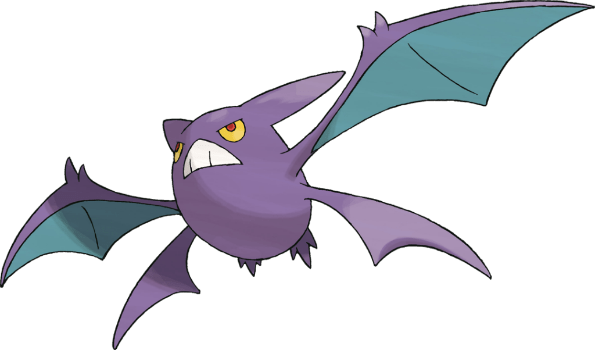
I have had many Crobats, two that stand out to me are Calcite and Leofsig.  Image from http://maestropkmn.blogspot.com/2014/03/estrategia-pokemon-crobat.html

But I remained a steadfast and loyal Poison Type fan.  I just love these guys, they are so much fun and they can be quite versatile as well, especially if they have a second typing.  Gengar, Nidoking, Crobat, Tentacruel, Dragalge, Toxicroak, and of course Bulbasaur are all Pokémon that I loved and trained for more than a decade.  They are like the underdogs in the Pokémon world; they may get the short end of the stick at times but man do I love them.

Poison Type’s position as a sub-par type began to change in Generation V when it, along with many other types, were given new moves and hidden abilities.  Nidoking now had Sheer Force, many of the moths got Quiver Dance, and Toxic’s accuracy rose to 90%.

My Nidoking was called Aragorn. Image from http://pokemondb.net/pokedex/nidoking

But Poison Type finally got to shine in Generation VI.  Poison became a Type to be feared, respected, and used.  Not only did a lot of Poison Type Pokémon got a small boost in their stats, such as Dustox, but an even more important event happened that made Poison viable for both the games and the metagame.

When the Fairy Type was introduced I was beyond excited.  Not only was this a new type, but now the dynamics between type relationships would be shaken.  In the Fairy Type’s introduction video, Gamefreak showed that Fairy would be super effective against the powerful Dragon Type.  Already this was big news but what was not revealed was what was Fairy weak against? Would Poison be good against Fairy?

Thankfully, my prayers were answered and I rejoiced.  Poison was only one of two types super effective against Fairy Type and one of three that resists it.  Now, Poison Type was good against the now prevalent Fairy Type and many Pokémon benefited from that.

But more importantly, Poison cemented itself as a great defensive type.  Immune to poisoning with resistance to Fighting, Bug, Grass, Poison, and now Fairy, the Poison Type is now a good type to use when inflicting statuses on opposing Pokémon.  And with Toxic now 100% accuracy for Poison Types, they are able to excel at it.

My Bulbasaur was sometimes named Cretaceous. Image from http://pokemon.wikia.com/wiki/Bulbasaur

The Poison Type is a great example how things change for each passing generation.  Sometimes, a few Pokémon may become worse, but most of the time, every Pokémon becomes slightly better, slightly more usable, slightly more appealing.  New moves, new abilities, and maybe even a stat or type change makes this so.  So when the remakes come out, such as ORAS, Pokémon that you may have skipped the first time around now gravitate you towards them.  Dusty is one of them, he is amazing and I’m glad I caught him.  He’s is one more Pokémon I can add to my most favorite Pokémon Type ever.


From Starter to Finish

With this week’s release of ORAS I thought I would write an article about Pokemon.  Pokemon is like second nature to me as I can write about so many random topics about it that it isn’t even funny.  But for this week I thought I would talk about where every Pokemon trainer’s story begin, the starter.

The starter Pokémon are some of the most recognized, most remembered Pokémon, especially for their respective generation.  It’s kind of bittersweet though as when each new generation is introduced, a new wave of starter Pokémon come by to represent it and the old starter Pokémon are then replaced.  But Pikachu keeps on staying that yellow bast-

Anyway, the starter Pokémon are the most important Pokémon to you.  Period.  Without them, you couldn’t have beaten the Elite Four, or acquire all eight badges, or even catch your first Pokémon.  They are the genesis of your journey.

Unfortunately, some trainers, including myself, may not keep them for all of their journey.  This is probably one of the worst sins you could commit in the Pokémon world.  Maybe you find other Pokémon you like better or maybe you’re just not a fan of them.  It doesn’t matter, you have sinned.  Go and confess your sins to Arceus (or your respective diety, I don’t want to be prejudice).

Okay, so for me, I had my starters from beginning to end in Generation I, Generation II, and Generation III.  Generation IV though was when I began to waver from this sacred tradition.  When I played the Sinnoh games the first time through I had Turtwig and then I eventually gave up on him…The second time I played through I had Piplup…and gave up on him as well…the most recent time was with Chimchar and for him I finally held onto into the very end.  I initially refused to play him because of my love for Combusken in the last game and I didn’t want another fire/fighting Pokémon.

Generation V though was when I really didn’t care.  Now let me say up front that Generation V is not my favorite generation at all.  After the amazing Generation IV, I was…not too pleased with Generation V for several reasons.  It didn’t help that I thought each of the starter Pokémon looked so…bleh.  I mean, I guess Snivy is cool…but man…Oshawott and Tepig just didn’t strike my fancy.  I gave up on them when they were only level 16 or so.  Poor guys.

Generation VI definitely fired on all cylinders.  All three of these starters were well-designed and definitely represented what a starter Pokémon should be like.  The best part was that there was not a dominant favorite starter for Generation VI.  Everyone I knew who played the game didn’t overwhelmingly go for one starter.

As for me, I chose Froakie.  When the initial line up was revealed I was somewhat torn which Pokémon I would choose.  It wasn’t until the reveal of the starter’s second stage that I made my decision.  Fennekin’s Fire/Psychic typing was tempting but I ultimately went for Froakie and his Water/Dark line up.  I can’t explain it but I just like his initially dorky look and his evolution to his final, cool and slick stage.

This is a decision that I do not regret.  Though Froakie is alright I actually like Frogadier more.  I probably stayed with this stage for most of the game.  That kind of bonding time really gets to you after awhile and I missed Frogadier when he eventually evolved into Greninja.  Many battles were won with this guy.

My love for Greninja actually increased after I finished Pokémon X.  When Greninja was revealed to be a fighter in Super Smash Brothers, I was happy but not ecstatic.  But once I played him in the actual game my adoration for him just went through the roof.  He’s great!  Granted, his Substitute move has been done before but I like his Shadow Sneak and his amazing jumping and running speed.

I also like how Greninja is portrayed in fancomics as pretty lax compared to the other two starters and just goes with the flow.  Check those out.

I actually recently made a poster for my university’s local geology conference that was enspired by Greninja’s color scheme.  I pretty much suck when it comes to color palate and layout for posters.  I decided to just screw it and base the poster off of his colors and the poster looks pretty good actually!

Greninja Poster

I should do this more often. For the curious, I used the eyedropper tool to get the exact colors of Greninja and then applied it to the poster. Background is body color, border is the head frill color, box color is part of the tongue while the darker pink is the other part of the tongue

In the end, Greninja is one of my favorite Generation VI Pokémon for many reasons and the best part is how my friends really like their starter Pokémon as well.  It really speaks volumes on how awesome Generation VI has been so far.

And with the release of Pokémon ORAS this week, we can continue on with the progression of Generation VI and Pokémon in general.  I’m especially looking forward to the releases as I like the starter Pokémon a lot.

Insert Mudkip Meme Joke Here. Image from http://bulbapedia.bulbagarden.net/wiki/Mudkip_(Pok%C3%A9mon)

Combusken is actually one of my favorite middle stage Pokémon of all time.  My love for this dorky Pokémon grew first from necessity as I desperately needed a Pokémon to take down Roxanne and her rock type Pokémon.  After that, I held onto Combusken for as long as I can so he can learn his moves as early as he could.  This method of evolving Torchic early and Blaziken late meant I spent so much time with Combusken that he eventually became my favorite stage of the three.

I have yet to decide if I’m going to pick Torchic again for ORAS as I already had one trained in X and Y.  I’m tempted to train Treecko since I haven’t picked him yet but I just love Combusken so much.  Regardless who I choose, I’ll guarantee you two things; one-ORAS is going to be great and two-whoever I choose, he’ll be with me from starter to finish in the wild lands of Hoenn.

If you have read through my article then riddle me this!  What’s your favorite starter?  I’m curious to hear!

No, there is no 9/11 reference in Pokemon Black/White

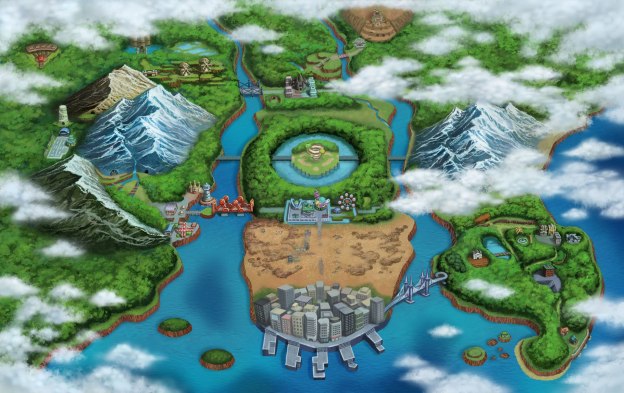
Pokemon Black and White introduced Pokemon’s Generation 5 to the world in 2010.  It marked a noticeable upheaval in the series as Gamefreak broke many of the series’ traditions.   One of the most obvious examples of this is a region, in this case Unova, that was not inspired by a place in Japan.  Unova had strong influences from the U.S.A. with a particular focus on NYC.  Castelia City for instance was inspired from Manhattan while Skyarrow Bridge comes from the Brooklyn Bridge.

But is the NYC inspiration more morbid than it seems?

Three years ago, Cracked.com published an article about The 9 Most Offensive 9/11 References in Pop Culture

You can see the original article here: http://www.cracked.com/article_19087_the-9-most-offensive-911-references-in-pop-culture.html#ixzz2eskwL8fK

In the number 5 spot is Pokemon Black/White where Fletcher Wortmann proclaimed that Nintendo’s game references 9/11. He does this from two different kinds of evidence.

The first one is that the barren wasteland (route 4) between Castelia and Nimbasa City represents Ground Zero from the 9/11 terrorist attacks. In the game, Route 4 contains buildings that are dilapidated. These ruins were supposedly caused by a meteor that fell from the sky and devastated the area.  The meteor represents the planes that brought down the two towers.

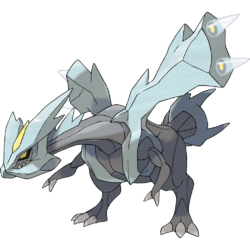
Kyurem, the second piece of evidence, was that respected meteor.  This 9/11 analogy is sealed up when the article points out that Kyurem is 9 feet and 11 inches tall.

kyurem

The problem with these two points of evidence is that if you actually played the game you would have found them to be simply not true.

One: Route 4 is a desert with actual desert storms and desert Pokemon. Not a site of devestation.

Two: The ruins are over 2500 years old and are dilapidated because of age, not of sudden destruction.  In fact, pokedex entries for the pokemon Sigilyph states that they are guardians for ancient cities.  Since they haunt the ruins we can therefore assume the ruins were not recently made.

Three: With the first two points in mind, there are no references in the game anywhere that a meteor “took out” this area.  However, the Giant Chasm region, where you can find Kyurem, was indeed formed by a meteor impact.  This meteor impact though is as far away as you can get from Route 4 and has no relationship to it whatsoever.  Even then, no buildings or cities were destroyed by it as it landed in a forest.

Fourth: Kyurem is 3 meteres tall which comes to about 9 feet and 10.11 inches. Not 9 feet, 11 inches.

It’s this kind of shoddy research that made me stop being a fan of Cracked.  I used to go to their site all the time but ever since this article came out, I slowly stopped visiting them.  Sure, you can be humorous for your articles even if they are sensitive topics BUT EVEN SO, you should still have your facts straight so you don’t misdirect your readers.  This is made doubly so for this article; since the author didn’t bother to double check his sources he is himself offending the 9/11 attacks by trivializing them in a Pokemon game.

The following post was adapted to a reddit post I posted last year on r/pokemon.  Original link can be seen here

Ancient Animals and their Fakemon: Oviraptor

Oviraptor: Therapoda Dinosaur, Late Cretaceous

The hubris of science can be ironic at times.

In 1924, a partial skeleton, known as AMNH (American Museum of Natural History) 6517 was found in the Mongolia desert next to an egg nest (AMNH 6508).  Discovered by Roy Chapman Andrews and later named by Harry Fairfield Osborn, AMNH 6517 became known as Oviraptor philoceratops.  Its name meaning “egg thief” and “lover of ceratopsians,” Oviraptor immediately became a hit and cemented itself in the pages of children’s books as the dinosaur that ate embryonic babies.

However, with such an accusatory name, no one knew what were inside the eggs.  Everyone assumed they belonged to Protoceratops due to their fossil abundance nearby.

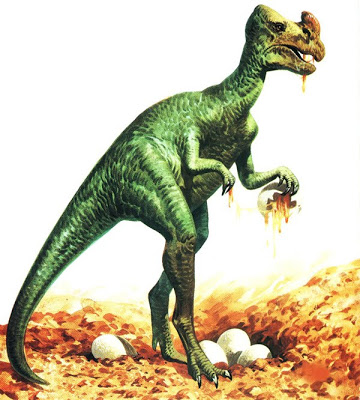
outdated oviraptor

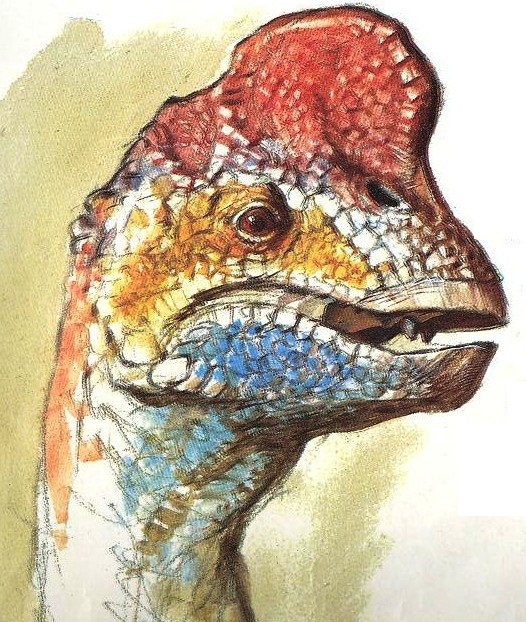
Oviraptor’s incomplete holotype also made it hard to determine what exactly it looked like.  The result gave them some hooooooorible paleoart.

Barsbold (1977) was among the first to question this hypothesis by analyzing the dinosaur’s skull and concluded that it had a powerful bite.  Powerful enough that it could eat hard shell organisms such as mollusks. Because of which a strict egg-only diet would make the strong jaws pointless.  Maybe it ate eggs but it probably ate a lot of other things as well.

Norell et al. (1994) finally threw credible doubt onto Osborn’s original hypothesis when they analyzed an Oviraptoridae embryo (IGM 100/971) still trapped in its shell.  IGM 100/971 looked so similar to AMNH 6508 that Norell et al. declared the latter specimen to be an Oviraptor nest.  The skeleton that was found with the nest was most likely a brooding adult and not an egg-stealing thief.

Off the top of my head, I can’t think of any other dinosaurian hypothesis that had made such a 180.  Here we have a dinosaur that was viewed with respite and now is looked upon with happiness.  To be fair, Oviraptor could have still eaten eggs as its diet but that’s not the point.  The point is that our perception of this dinosaur has changed from a baby-killing bandit to an offspring-concerned parent.  That is hilarious.

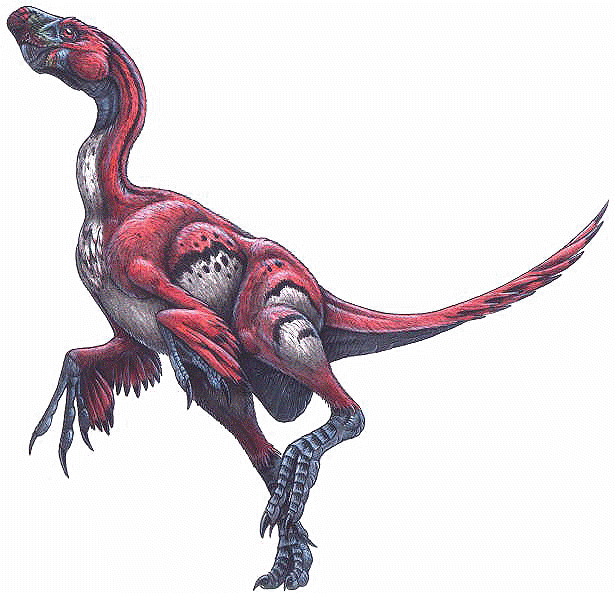
Oviraptor can also be found in the Flaming Cliffs of the Gobi Desert along with a host of other animals.  There are the small lizards and mammals and of course other dinosaurs.  Most famous of which would be Velociraptor and its rival Protoceratops, along with the weird Therizinosaurus and the ferocious Tarbosaurus.  The rock record also reveals, interestingly enough, that the climate of the time was probably similar to the modern day Gobi Desert.  A braided, teaming with life, river dominated the otherwise dry, sandy environment (Fastovsky et al. 1997).  Some dinosaurs were even uncovered in a desiccated position with their head pulled back and their spine extremely arched.  Some were just completely buried by a sandstorm such as the Oviraptor specimen discovered by Andrews.

Dinotopia, Oviraptor

From Dinotopia: A Land Apart from Time

Oviraptor has not shown up much in pop culture.  I know of two occasions; one in the documentary Dinosaur Planet and the second in the first Dinotopia book.  In the book, Oviraptor was instead called Ovinutrix (“egg wet nurse”) and they took care of dinosaur eggs in Romano’s Hatchery.  The twist?  The book came out in 1992.  Two years before Norell et al. took down the egg eating hypothesis.  What was supposed to be taken as a humorous joke instead came out as a concept that was not scientifically outdated.  What’s more, James Gurney’s, the author of Dinotopia, name change righted a wrong that should have never befallen the dinosaur in the first place.


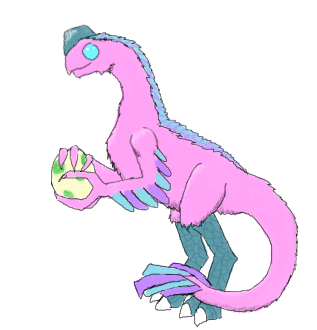
OVALOOTER

Fakemon, Oviraptor, Ovalooter

Type: Fairy/Ghost

Stats: HP: 80,   Attack: 80,   Defense: 70,   Special Attack: 80,   Special Defense: 60,   Speed: 90

Ability: Pick Up, Frisk

Moves Learned Upon Leveling Up:

Start-Covet

Start-Tail Whip

6-Confusion

9-Baby Doll Eyes

13-Sand Tomb

17-Charm

22-Bite

27-Fling

31-Light Screen

35-Soft Boiled

39-Bestow

43-Disarming Voice

47–Play Rough

52-Earthquake

Learnable TMs and HMs: Hone Claws, Dragon Claw, Psyshock, Calm Mind, Roar, Toxic, Hidden Power, Sunny Day, Light Screen, Safeguard, Frustration, Solar Beam, Smack Down, Earthquake, Return, Dig, Psychic, Double Team, Reflect, Sandstorm, Rock Tomb, Aerial Ace, Façade, Rest, Attract, Thief, Round, Echoed Voice, Steal Wing, Fling, Psych Up, Dragon Tail, Sleep Talk, Substitute, Confide

Egg Group: Field

Held Items: Oval Stone: 50%

Pokedex Description Version One: It loves to collect egg-shaped objects.  It’s not unusual to find one with eggs from other species.

Pokedex Description Version Two: It raises the babies of other pokemon it has found.  Prototops are the most common species they take care of.

Evolution: None known at this time

Basic Background: While driving with my gf two months ago, I said aloud, “You know, all my Ancient Fakemon came out before Generation VI.  I have no Fairy Type fakemon.  I should come up with one.” And it was right there and then that Oviraptor sprang into my head.  Of course!  Many modern paleoart interpret Oviraptoridae species with elaborate feathers.  If dinosaurian pokemon had fairies it would be the ones with elaborate feathers.

From there, she and I played around with it until we had what we wanted.  Unlike the previous two entries where I had them totally figured out and she just did the art, for Ovalooter, we came up with the ideas, design, naming, and so forth on an equal basis.

It was certainly fun coming up with a fakemon from scratch as it had been awhile for me.  This one I kind of let loose and enjoyed myself.  Ovalooter is basically a combination of Chansey and Linoone in that it just steals eggs and such and raises them as their own.  I love it.  Being a desert pokemon, Ovalooter was almost required to have that Ground Secondary Typing.  It is similar to the Nidos, Krookodile, and Flygon as Ovalooter is more of a field based pokemon and less a digging pokemon.


Barsbold, R., 1977. Kinetism and pecual structure of the jaw apparatus of oviraptors (Therapoda, Saurishia). Sovmestnaya Sovetsko-Mongol’skaya Paleontologicheskaya Ekspeditsiya Trudy, vol 163, p. 34-47.

Fastovsky, D.E., Badamgarav D., Ishimoto, H., Watabe, M., Weishampel, D.B., 1997. The Paleoenvironments of Turgrikin-Shireh (Gobi Desert, Mongolia) and Aspects of the Taphonomy and Paleoecology of Protoceratops (Dinosauria: Ornithischichia).  Palaios, vol 12, p. 59-70.

Norell, M.A., Clark, J.M., Demberelyin, D., Rhinchen, B., Chiappe, L.M., Davidson, A.R., McKenna, M.C., Altangerel, P.,  Novacek, M.J., 1994.. A Theropod Dinosaur Embryo and the Affnities of the Flaming Cliffs Dinosaur Eggs.  Science, Vol. 266, No. 5186, p. 779-782


Ancient Animals and Their Fakemon: Introduction and Dunkleosteus

Since 2007, I have been working an extensive side project that combines two of my favorite things in life; Paleontology and Pokemon.  Basically, it was pokemon that was directly inspired from actual paleontological animals.  It was originally supposed to be a fanfic where ancient pokemon were coming through time portals and the protagonist had to figure out why it was happening before major damage happens.  However, the story was so big that I didn’t have the time or patience to do it.  The idea also resurfaced again years later when I came up with the notion of having my ancient fakemon in an RPG.  It too didn’t work out.

But the results of my hard work did not fade away; I had kept many entries where I meticulously wrote tons of data on these ancient fakemon.  Now that I have a blog, I thought now was probably the best time to show the world these creations.  Starting today, I will publish a post describing an ancient animal (what is it, why I like it, any interesting tidbits) and its inspired fakemon (typing, stats, moves, their initial roles in the storyline and such).  These posts will only be released on Fridays, however, not every Friday will have an Ancient Fakemon post.  I hope you enjoy them.

And brother, I think I picked a good one to start with.

————

Dunkleosteus: Placoderm organism, Late Devonian

dunkleosteus

Image created by and is found on http://www.sebmeyerart.com/

I fear this animal.

I can’t explain why exactly, maybe it’s the soulless eyes, maybe it’s it terrifying appearance, or maybe it’s something else entirely.  Whatever the case, I do not want to be in the water if this fish is swimming about.

Dunkleosteus terrelli is a placoderm, a relatively successful group of bony armored fish that dominated the seas during the Devonian Period.  This unique group of animals died at the end of the Devonian Period leaving no modern day relatives.  They are classified by their armor plated body structure which gave them protection at the sacrifice of speed.  Most of them were bottom dwellers and clung to the seafloor.  The Arthrodirans, a group within the placoderms, escaped the seafloor and actively swam in the water column.

Dunkleosteus is one of those Arthrodirans.  The largest placoderm discovered; Dunkleosteus could reach up to 10 meters in length. Its “teeth” were not traditional teeth like you and I have but modified bone that functions as teeth.  The blade-like “teeth” could continuously sharpen as the predator was feasting on its prey which is pretty wild.

DunkleosteusSannoble

Dunkleosteus status as the top predator in the seas is well founded due to its size and biting behavior.  Anderson and Westneat (2009) estimated that Dunkleosteus could open its huge mouth in about 60 milliseconds.  This rapid expansion created a vacuum which sucked water and prey into its mouth.  Once the prey was in its mouth, Dunkleosteus would then crush or pierce its prey from as high as 6170 N at the tip of the mouth to a staggering 7495 N at the back of the mouth (for reference, we can only bite at 294 N at the tip of our mouths).  This bite force is so large that only the great white shark and the alligator can match it (see Huber et al. (2005) for a general list of animal bites and Wroe et al. (2008) for shark bites).  Both of these methods meant that Dunkleosteus was feeding on prey that was both elusive and armor-covered such as ammonoids, arthropods, and other placoderms (Anderson and Westneat 2009).

Dunkleosteus, Dinotopia

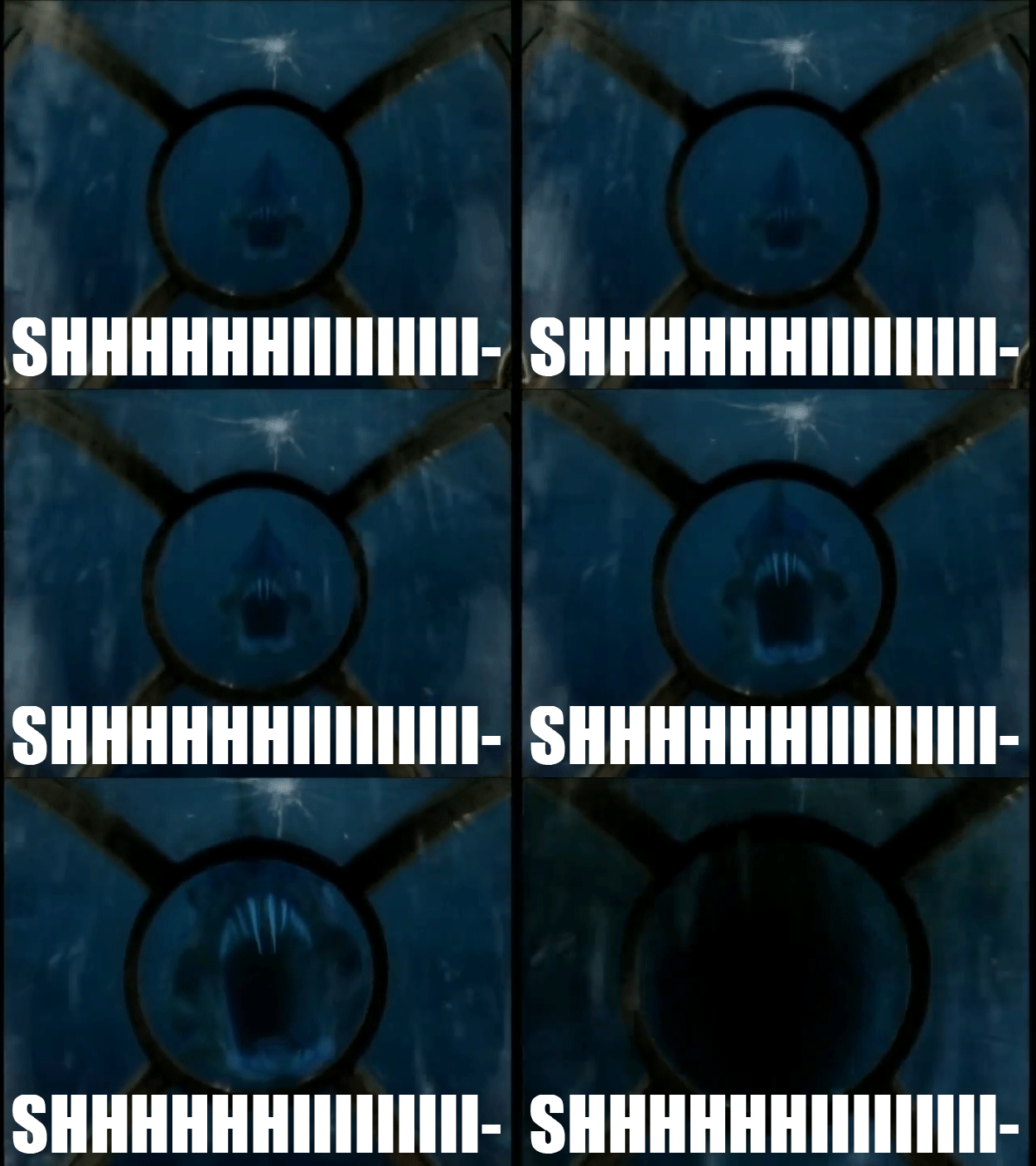
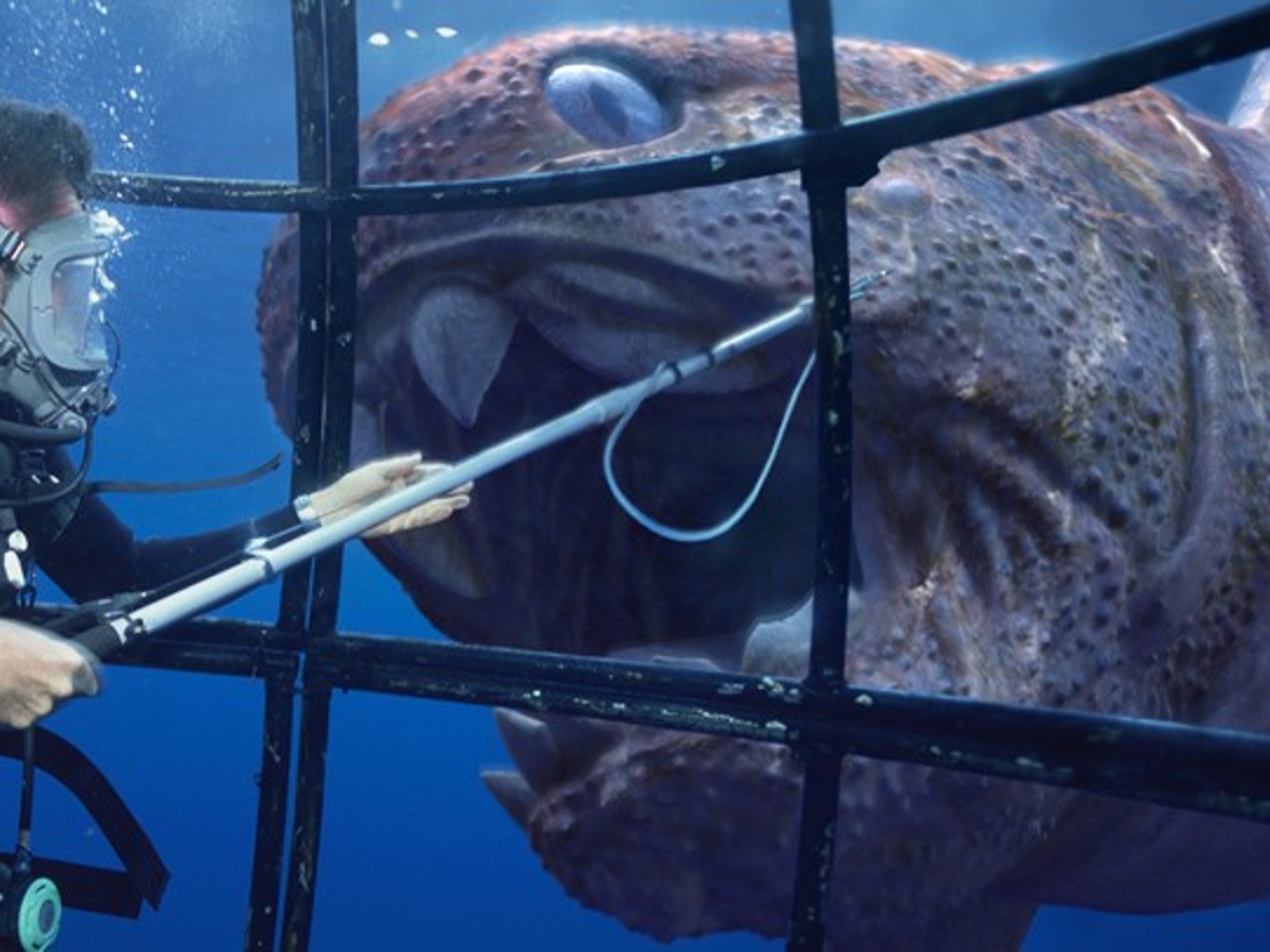
Dunkleosteus has shown up a few times in pop culture.  The first time I saw him was actually in the second Dinotopia book, The World Beneath, where the armored fish snapped off the claw of the protagonists’ underwater ship and briefly fought a Kronosaurus.  The second time I saw him was again in Dinotopia only this time it was in the tv movies (where he was also terrifying albeit more angler fish-like).  Dunkleosteus most famous appearance would probably be in the BBC’s Sea Monsters where Nigel Thornberry Marven journeyed to the seven deadliest seas in Earth’s history.  Dunkleosteus and his Devonian Sea was ranked the Fifth Most Deadly Sea.  Nigel wanted to interact with a Dunkleosteus so he got into a round shark cage and tried to get a closer look at the fish.

I WILL EAT YOUR SOUL

“I WILL EAT YOUR SOUL!!”

I have to say, if that was me, that would be a big bag of nope.  Like I said before, I fear this creature so I don’t want to be ANYWHERE near this guy when I’m out on sea.  God, being eaten by him would probably be a cross between a shark and a hippo. *shudder*

——–

CLUNKLESTEEL
Clunklesteel, Fakemon

Type: Water/Steel

Stats: HP: 82,   Attack: 125,   Defense: 125,   Special Attack: 55,   Special Defense: 78,   Speed: 55

Ability: Strong Jaw.  Hidden Ability: Hyper Cutter

Moves Learned Upon Leveling Up:

Start-Splash
Start-Iron Defense
15-Flail
20-Bite
22-Water Sprout
25-Headbutt
29-Shear Bite
33-Glare
37-Thunder Fang/Ice Fang
40-Metal Sound
43-Skull Bash
46-Screech
50-Aqua Tail
53-Crunch

Learnable TMs and HMs: Roar, Toxic, Hidden Power, Protect, Rain Dance, Safeguard, Frustration, Return, Brick Break, Double Team, Sandstorm, Rock Tomb, Façade, Rest, Attract, Round, Scald, Stone Edge, Rock Slide, Swagger, Sleep Talk, Substitute, Flash Cannon, Rock Smash, Snarl, Confide, Surf, Strength, Waterfall

Special Moves: Shear Bite: Steel Type, Power: 40, PP: 20, Accuracy: 100%.  Sheer Bite raises the user’s Attack by one stage after damaging the opponent.

Egg Group: Water 2

Pokedex Description Version One: Scientists can tell how old a Clunklesteel is by the amount of rust that grows on their backs.

Pokedex Description Version Two: Clunklesteel have been known to ram small boats and even pierce the hulls using their steel-bladed teeth.

Basic Background: Clunklesteel is based off of Dunkleosteus.  Clunklesteel was one of the easiest fakemon to come up and play around with.  The armor nature combined with his fish status means he makes a great Steel/Water type pokemon.  The Ability Strong Jaw also fits perfectly with his terrifyingly biting force.  His famous chompers means that biting moves like Crunch or Thunder Fang are great compliments to him.  Clunklesteel’s nature means he has great Defense and Attack at the cost of his Speed and Special Attack.

Shear Bite is a move made specifically for Clunklesteel.  The continuously sharpening of his blade-like chompers fits well as a move.  Shear Bite is the Steel Type version of Power-Up Punch.

Clunklesteel played an important part in my story.  Originally, the protagonist had met a Clunklesteel when he was a kid and was traumatize by it and has since been afraid of the ocean.  The same Clunklesteel had come back when the protagonist unknowingly released it and a bunch of other prehistoric animals at a terrorist facility.  The Clunklesteel began to hunt him relentlessly and violently defeated the protagonist at every battle they met.  Each time, he was too scared to act confidently in the face of his feared foe.  One of the battles even cost him his pokemon.  It wasn’t until near the finale of the story when the protagonist had finally faced his fear, defeated it, and captured the placoderm pokemon.

I always imagined him as being a mindless machine and with this design that my girlfriend came up with, that mindless machine really shined through.  Don’t think, just eat and go, eat and go.

Finally, Clunklesteel evolves from Sillylepis (formerly Placoderp before that term became controversial) and is based off of Silurolepis, a primitive placoderm found in the Late Silurian.  Sillylepis evolves at level 20 to Clunklesteel and is similar to Magikarp due to both having poor stats and a poor moveset.

Alternative Names: Placodoom, Placodeath, Dunksteelus

I hope you enjoy the first Ancient Animals and Their Fakemon!  When time permits, I’ll make more of these later.


REFERENCES

Anderson P.S.L., Westneat M.W., 2009.  A biomechanical model of feeding kinematics for Dunkleosteus terrelli (Arthrodira,Placodermi).  Paleobiology.  35:251-269.

Huber D.R., Eason T.G., Hueter R.E., and Motta P.J., 2005.  Analysis of the bite force and mechanical design of the feeding mechanism of the durophagous horn shark Heterodontus francisci.  The Journal of Experimental Biology. 208:3553-3571.

Wroe S., Huber D.R., Lowry M., McHenry C., Moreno K., Clausen P., Cunningham E., Dean M.N., and Summers A.P. 2008. Three-dimensional computer analysis of white shark jaw mechanics: how hard can a great white bite?  Journal of Zoology. 276:336-342.

And Berkeley website on the “Introduction to the Placodermi” http://www.ucmp.berkeley.edu/vertebrates/basalfish/placodermi.html