This Could Work-A Total War: Great War Game

Revolt, Rebellion, Revolution.  These three “R”’s are the magic words that help define both the Creative Assembly-produced Total War video game series and the awful Great War which is currently “celebrating” its centennial anniversary.  I am both surprised and not that these two topics haven’t come together to produce an in-depth, strategy-filled game that takes place during the Great War-era.  This game has the potential to be amazing but it could very easily be bogged down with bloated mechanics and stretches of time where you do nothing but click the next turn button.

I first thought about this marriage while I was playing both Empire: Total War and Napoleon: Total War.  Compared to other Total War games, both of these games take place relatively late in human history representing late 1700s and early 1800s respectively.  The use of guns and canons is a far step forward compared to the arrows and swords Total War embraces in its Rome, Medieval, and Shogun settings.  But, they are done surprisingly efficient especially when combined with cavalry and fortresses.

The Great War is also extremely perfect when playing as certain factions.  You can play as Britain, Germany, France, Austria-Hungary, Russia, and maybe even Ottoman Empire and Italy.  All seven of these nations fought in huge conflicts that ranged throughout a greater part of Europe.  And it’s not like the Great War: Total War would restrict you to certain allies or enemies.  You could start the game in say, 1900 (or even 1870 if you want to include the Franco-Prussian War) and have all the participants naturally decide their allies on their own accord.  It would be very similar to the board game Diplomacy now that I think about it.

The United States (and other foreign powers) could also play an important role in the game even if the map focuses only on Europe.  All these countries can play as a neutral to a less-than-neutral position at the beginning of the game.  Do you choose to sink a neutral power’s supply ships in hopes of hurting your opponent?  That may backfire and the neutral power could declare war on you (and your opponent could get maybe 10 more, free, soldier units or something).  Perhaps you could win over a neutral power through diplomacy, gifts, and trade agreements.  The choice is yours to make.

Given this is the late Industrial Era; you can have many improvements for your home country such as the usual factories and farms but even infrastructures such as railroads, electricity, and telecommunication.  Man, you could transport your armies so fast if you built railroads in your homeland.

The three “R”’s would also play a huge role in this game, perhaps more so than other Total War games.  Worker riots and soldier mutinies run rampant during the Great War, then you got the occasional independence rebellions like the one the Irish started in 1916 and of course, you got some major Russian revolutions to cap it off.  Soldier morale could also be affected by say recent gas attacks, current weather, or battles where many soldiers died and nothing was gain from it.  Whole units of soldiers can lay down their arms or even fight you in response to the awful conditions!  Also, can you imagine sending terrorists or instigators to your rivals in hopes of stirring a revolution?  That would be awesome!  On the one hand, you would have to keep your people happy but on the other, you can cause chaos from the inside out!  The Austria-Hungary Empire could disintegrate before your very eyes as armies representing different nationalities spring up and take back cities belonging to the people!

And maybe get a certain Archduke assassinated to start off a major conflict…? Image from http://en.wikipedia.org/wiki/Archduke_Franz_Ferdinand_of_Austria

Although a Great War setting is not a far cry from Empire or Napoleon and can be done easily there are a few key differences that have to be addressed.

The first key difference, machine guns, and by extension trench warfare, were such an integral part of the Great War that it’s hard to find one without the other.   So many soldiers were killed on both sides by these weapons of war that it was probably one of the main reasons why stalemates happened all the damn time.  This is where a Great War: Total War game can be frustrating if not done right.  Your own soldiers can be killed en masse after several machine gun units mow them down.  Though historically accurate, it’s not very fun to play with (except when you’re the one shooting of course).

As such, you can do several things to nerf the power of machine guns.  For one thing, they are a better defensive than offensive weapon.  As such, soldiers carrying them would be quite slow and cumbersome.  The soldiers can also only fire them for so long before the gun either jams or overheats making them not very effective for long battles.  Technology upgrades can fix these overheating issues somewhat but you still wouldn’t be able to fire them for very long.

Gas grenades and shells would be easier to incorporate as they’re basically a stand in for the howitzers.  You could probably do some sort of penalty against soldiers with tear gas (like they’re slowed down, do not fire as well, or morale is lowered) but the awful chlorine gas is where things truly matter.  Not only would there be a lot of fatalities but it would be a good morale killer for even hardened veterans.  And of course, one of the first technology upgrades you can get for the soldiers is the ability to wear gas masks which would be represented as a button on the tool bar during the real-time battles.  The gas masks might lower accuracy and make your soldiers tire faster but at least they’re not being gassed at.

Tanks would be another technology upgrade you could easily incorporate into the game.  At the beginning of the game, you could have cavalry units for horses which although they might be useful very early on (especially if we’re starting the game 1870), they can soon be antiquated by the arrival of the machine gun.  Tanks wouldn’t make their appearance into very late in the technology tree but once they do, they can easily smash through defensive lines of barb wire and trenches.  Still though, they would be expensive to produce and they would be rather slow and have the chance to break down (again, trying to make sure they don’t become OP).

But the most difficult technology to incorporate would be airplanes.  Though it would be easy to use biplanes for reconnaissance or blimps to bomb distant cities, the real-time strategy would be much harder to handle if it’s used at all.  The real-time section of the games work on a (mostly) two dimensional terrain and adding aircraft to the mixture would make them impossible to control, much less use them for their full potential.  Perhaps you can send in a squadron to bomb a certain part of the map during the overworld phase.  Maybe a passive advantage is an added accuracy bonus for artillery allowing them to hit a group of soldiers on target.  Though both of these sound acceptable, they still don’t really use the planes to their fullest capabilities.  This will need to be played around with before aircraft are fully realized.

I really hope the Total War series makes a Great War game.  After thinking about it and writing all the potential it has, I really think it could work very well.  The lack of a prominent Great War game should be filled by a prominent series.  The Total War series is that game as its elements of nation building and alliance forging go perfect with the Great War along with its real time strategy on the battlefield.
Adventure Hat

If my Soul gets Removed from my Body, Please, Please, Please use my Adventure Hat to get it Back

In the summer of 2009, I was going on my first geology field trip soon and I knew I needed an Adventure Hat.

The problem was, for whatever reason, it was difficult for me to find a hat that fit my head perfectly.  I remember one time I was trying on a hat and it didn’t fit me quite right, looking at the tag, I read “One size fits most.”  But after much looking around, I found one and it has been by my head ever since.

I have been with this hat longer than I have known my girlfriend, many of my current comrades, and all of my nieces and nephews.  It has been with me so long that many of my peers and acquaintances recognize me from a distance solely based on me wearing this sucker.  It has traveled with me from cities to the middle of nowhere, through rainstorms and snow, through deserts and forests, and glared by the blazing sun and splashed by a beach’s salty waves. It has traveled to Istanbul, DC, Paris, San Diego, and even the little town of Drumheller, Alberta.

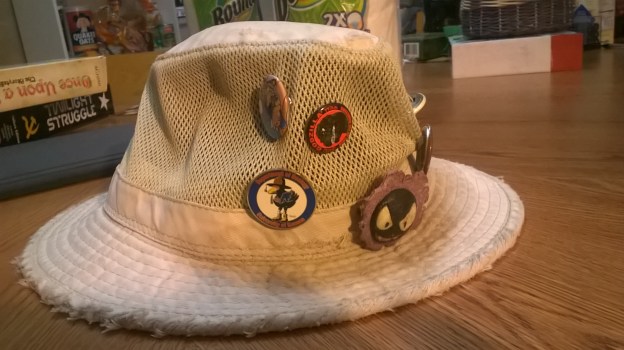
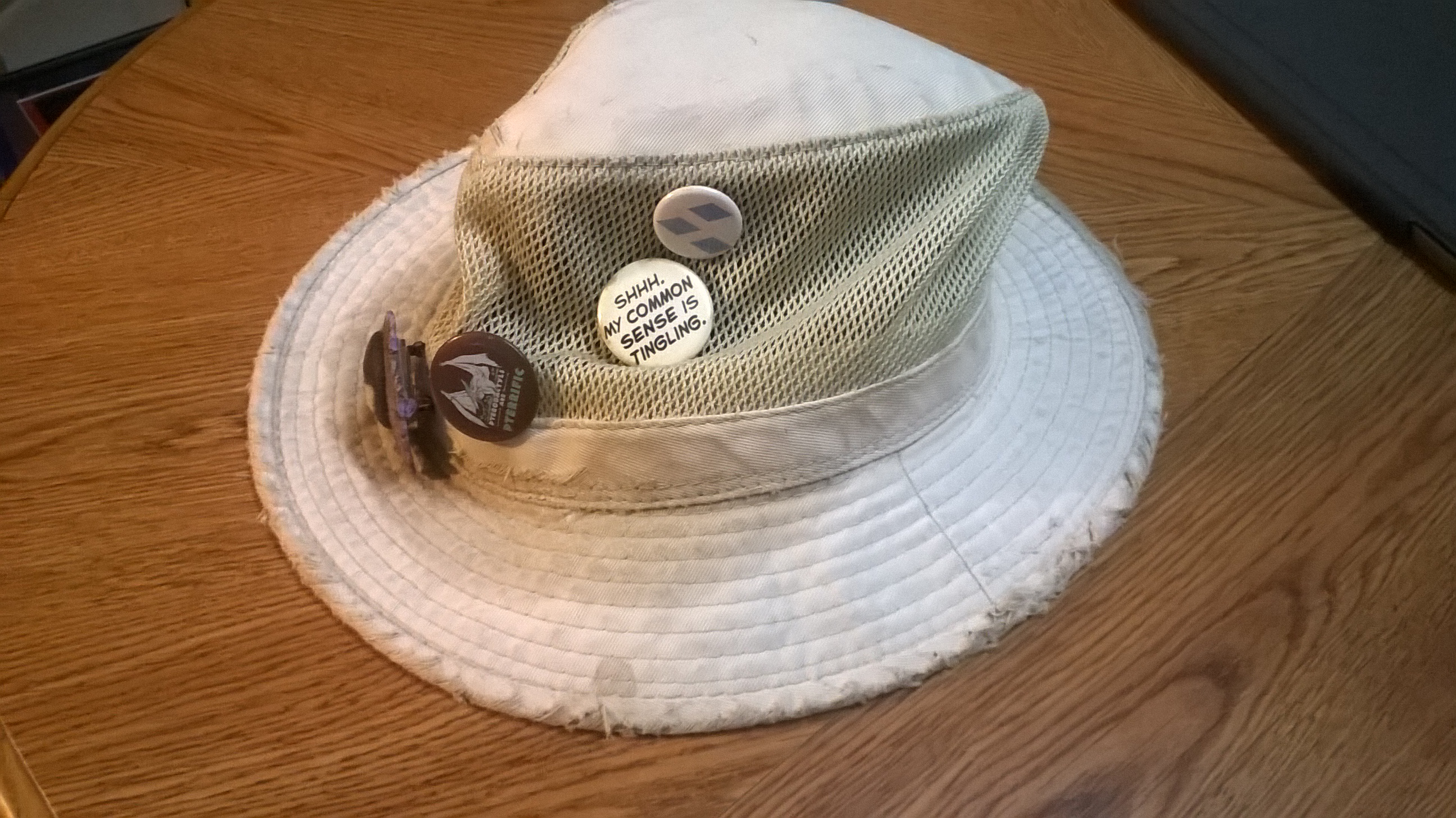
Pins adorn the hat to the point that some may call tacky or compare it to a car’s bumper overfilled with stickers but I don’t care.  They are pins that describe me, or are part of my identity, or I just find interesting.  The constant exposure to the elements has made their needles rusted over time but they hold firm to the Hat.

I can’t tell you how many times I have lost my Adventure Hat.  Sometimes, I may simply have misplaced it, but other times, it will be gone for weeks at a time.  One time, I was over at a friend’s house, I was sitting on her couch and I took off my Hat and set it on top of the couch.  The Hat slid off and fell behind, trapped in the shadows of the netherworld.  I then left her place and forgot about it (I do that a lot unfortunately).  It wasn’t until I came back almost a month later that I found it again.

All of its adventures have taken a notable toll on this hat.  Its edges are frayed, the color has faded, a sweat stain spreads slowly on the brim, and holes form previous pins are scattered throughout its exterior.  And yet, I still wear it because it does its job right.

Adventure Hat

But I have grown very attached to this piece of fabric despite its aged appearance.  As such, I have a request…

If my soul gets separated from my body for whatever reason and you need a material object to bring it back, PLEASE USE MY HAT!  I can’t emphasize that enough.  It will make your life sooooo much easier if you use my hat (provided I hadn’t lost it again).  Also, if I’m possessed by some raging demon from the fifth dimension and I’m shouting how bad you smell, use the Hat.  I swear, I bet this hat is filled with some sort of luck charm or whatever based on how many times I have lost and found it.

I wouldn’t be surprised if a part of my soul is even in the Hat itself.  If I had a horcrux, it would be the Hat.  No shocker there.  The best part is that if I died, all I need is somebody to take the hat and wear it temporarily.  My soul could then slowly take over there body!  Soon they’ll be wearing socks with sandals, sing Gilbert and Sullivan, and write pointless blog articles on the internet!  The problem with that is no one would wear such a tattered thing!  You might as well just bury it with my body for all the good it will do.

This Hat means a lot to me and I still find it useful to this day.  I’m looking forward to taking it with me to Fossil Butte National Monument where I’ll be a park intern this summer.  It’s going to be so awesome wearing my park uniform with my Hat!  My Hat has been with me for many years, and I hope it will keep on, keeping on for more years to come.

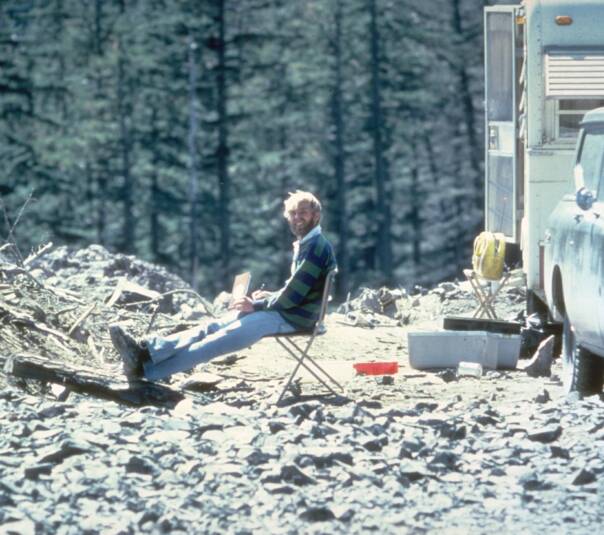
He Died as He Lived: David A. Johnston

To summarize the importance of Dr. David A. Johnston and his work on Mount St. Helens in an 1000-word blog article is a nigh impossible task given the impact he had on volcanology and the infamous volcano he studied. I always wanted to write about him ever since I wrote my first HDaHL article featuring Karl Patterson Shmidt but I struggled to do so considering this was a man whose legacy saved lives.

Let me back up, Johnston was a USGS volcanologist who had a personal history with volcanoes both active (Augustine Volcano in Alaska) and extinct (volcanoes in Michigan). His insightful knowledge in volcanology got him hired to study Mount St. Helens in March 1980.

Mount St. Helens is a composite volcano with a history of periodic eruptions. After its last few eruptions in the mid-1800s, Mount St. Helens became active again in March 27th, 1980 when steam erupted from it after a 4.2 magnitude earthquake struck it in March 20th. The volcano’s continuous activity prompted a response from the state government to close off many areas that were proximally located to the volcano.

Dr. Johnston continuously monitored the volcano for the next two months. Sometimes, he became so involved with his work that he would climb into the volcano’s active crater to perform experiments on it. Understandably, Johnston was terrified but he knew he had to risk the tests in order to learn more about volcanoes and how much of a threat Mount St. Helens was.

On May 17th, Johnston replaced his student, Harry Glicken, at the Coldwater II outpost, located five miles north of Mount St. Helens. He thought this outpost would be safe from an eruption but unfortunately, that was not true. On the morning of May 18th, Mount St. Helens erupted and its signature lateral blast destroyed everything north of the volcano, taking Dr. Johnston’s life in the process. Before his death, he was able to contact his USGS colleagues in Vancouver and was able to utter his famous last words

“Vancouver, Vancouver, this is it!”

before his radio was cut out. His words were that of excitement and not dread and were the response to two months of anticipation to the now awaken giant. Fifty-seven people, including Johnston’s life, ended that day. It is estimated that hundreds, perhaps thousands of deaths were prevented on May 18th, due to Johnston and other scientists’ insistence in keeping the area around the volcano closed from the public.

Johnston’s work on volcanism, especially on Mount St. Helens, should not go unnoticed and there are plenty of webpages around the internet that highlight his accomplishments. Instead of talking about his accomplishments, I want to focus instead on how people remember him and the differences between him and Karl Patterson Shmidt.

Johnston is thankfully recognized on his volcanic work ranging from scholarships, to documentaries, to having the Johnston Ridge Observatory at Mount St. Helens National Monument named after him. One documentary, the Fire Below Us, however, barely spoke about him having instead inserted a random interview he gave to the press along with his famous last words. “St. Helens,” a movie that premiered in 1981, had him as a primary character (although he is called David Jackson) though his portrayal in that film, from what I gathered, is very poor, painting him as a rebel and not as a cautious scientist.

Now, why is David Johnston more revered than Karl Patterson Shmidt? Both are scientists who died doing the things they love and both provided life-saving information to their respective fields. Well, the first thing that comes to my mind is that Johnston’s continual persistence in keeping the vicinity closed around Mount St. Helens is the stuff history loves to tell. We love those stories of the one man who was right, trying desperately to save the people around him even when others think him wrong (similar to Jaws now that I think about it…). Johnston’s actions against the grain is a triumphant victory.

Less romantically speaking, Johnston was going toe to toe with force of nature that he knew could kill him at any moment. I can imagine only a few people who would be willing to go out to an active volcano to actively perform observations and experiments on it. Johnston once quoted that Mount St. Helens was a “dynamite keg with the fuse lit.” With that kind of analogy, you have to hand it to the guy for continuing his studies even when death was literally right below him.

Even though Johnston thought his outpost was safe, he was still killed in the blast. This is almost similar to Schmidt’s reaction to the baby boomslang snake biting him at the tip of his thumb. Schmidt thought the snake was harmless and the bite won’t kill him. Yet Johnston’s outpost was based on careful predictions on the volcano’s eruption path. If Johnston was willing to not only have himself and his student stake out this area for observation, you can be sure he was confident in his predictions. Schmidt, on the other hand, did not fully grasp the dangers of the snakebite even when his health was failing him. As such, Johnston, unlike Schmidt, knew he was in danger and was willing to face it every day.

Finally, Johnston saved lives. Hundreds or thousands of lives were saved on May 18th thanks to his persistence along with other scientists. Though Schmidt gave us crucial information on the boomslang bite, determining how many lives he saved is quite hard to gauge. What’s more, boomslang bites symptoms would have been revealed to us sooner or later if Schmidt wasn’t as unlucky as he was that day. Johnston saved lives in one geologic instant. And that instant was all that mattered.

I highly encourage you to look more into Johnston’s life as he was a fascinating man with much to contribute in volcanology. Any webpage talking about him will do but you should also visit the Johnston Ridge Observatory. I’ve been to it before and man, it’s fantastic, definitely one of the best visitor centers I have been to (and the monument is quite beautiful as well).

Evolution Flight Expansion and an Extinction Expansion Idea

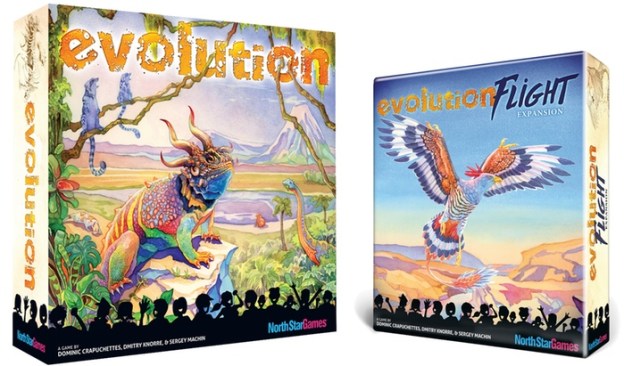
As a paleontologist, I love the crap out of the board game Evolution.  Designed by a Russian biologist, you win Evolution by having the most successful (i.e., most populated) made-up species.  You can have more than one species who can even cooperate with each other to help you win the game.

A simple concept but it’s the animal’s traits that really seal the deal for the game.  Giving your animal “Horns” or “Hard Shell” can help deter would-be predators.  Giving your animal “Long Neck” or “Scavenger” can help them survive tough rounds when food supply is low.  Giving your predator “Pack Hunting” or “Ambush” can give your animal an edge over the harder-to-kill prey.  You can add or change new traits as you progress through the game providing you the ability to adapt to your opponents’ strategies.

This is a fun game to play and I know I’m not the only one who enjoys it.  Many of my friends who have played this game once or twice are immediately hooked by its simple but endearing concept.

But unfortunately, there are a few problems with it that I feel need to be addressed.

Let me start with a problem that occurs depending on who you play with.  At the beginning of each round you add food tokens to the Watering Hole and these food tokens are what your species eat.  If there are not enough food tokens for all the species, your animal can starve and potentially go extinct.   This is determined by the cards you add to the watering hold which can range from negative to positive numbers.  The problem is that many of my friends throw in positive numbers in fear of the watering hole running out of food tokens.  As such, the starvation aspect of the game is downplayed so much that it can cause the game to be imbalanced towards already highly successful species.

But some people want to watch the world burn and purposely throw in negative numbers making for more enjoyable and competitive games.  So this is a minor issue.

An actual issue I have is the runaway success between two traits that can be exploited easily.  In the game, if one of your species has the “Warning Call” trait, it prevents another one of your species to be attacked by your predator.  If you pair this up with the “Symbiosis” trait (a species prevents a smaller species from being eaten), then you get an unwinnable combination that is hard to stop.  Sure, you can get the “Ambush” card to negate the “Warning Call” trait but you still have to be bigger than the “Symbiosis” species in order to deal any real damage to it (not to mention the “Ambush” card is an uncommon card).

There are other traits (e.g., “Hard Shell” and “Defensive Herding” in particular) that can be exploited to various degrees but none are as effective as this winning combo.  More often than not, herbivores dominate the board game landscape even when the predators get the amazing “Pack Hunting” trait at their call.  It’s rare to have a predator that is actual top dog.

From boardgamegeek.com

If you’re a reader of my site then you know that I’m a paleontologist.  As such, as I’m playing through this board game with all my friends, I keep thinking what I can do to improve it, to refine it, and to enhance the quality of the game while embracing the awesomeness of evolution.  There are so many animal characteristics out there that can be exploited that this game hasn’t even touched like camouflage or flight.

And guess what!?!?  The creators behind Evolution are doing an expansion for Evolution called the “Flight Expansion!”  Not only have they gone back and refined the original cards, they also added so many new traits as well including flight, camouflage, keen eyesight, and more!  And oh my god the changes!

Oh. My. Arceus. Yes.  All the problems I had in the first game are now being addressed.  This kind of response to balance issues in board games is simply great.  I can’t wait to get this game.  The expansion is on Kickstarter right now.  We still got two weeks until this Kickstarter is done but don’t worry as they are already well past funding!  I was very happy I found out about the Kickstarter thanks primarily by blogger http://ohjoystick.com/

Okay, so the Flight Expansion looks promising.

But I want to indulge a bit in what I think would be a great Evolution expansion.

As I already briefly talked about, there can be a runaway effect in Evolution where one person’s species becomes so large that no other animal can take it down.  They can then just up their population count and continue to eat a lot of food prompting them to win the game.  The updated “Pack Hunting” trait can solve that issue thankfully but even still, I would like to see some change on a major scale.

Evolution has been greatly affected by extinctions from a local to a global scale.  Species survive, outcompete, or die out due to changes in their environment.  The ruling class dies and the underdogs rise up to take their place as kings.  The characters may be different and the setting may be new but the plot is still the same.

And so I say, why not have an Extinction Expansion for the Evolution Board Game?

This expansion can upset the game’s foundation to the point that people who may be succeeding during the game now find themselves in a dire situation.  Those who were struggling now have the opportunity to overtake their now weakened (or even dead) competitors.  The possibility of different extinction events affecting species with various sizes, populations and traits is amazing and I feel giddy just thinking about it.

So, how would it work?  The way I imagine it is that at the end of every round, an extinction event card is drawn to determine if an extinction has occurred.  3/4th of the time, nothing happens.  However, for that 1/4th of the time that something occurs, the players have to do what the card says.  Here are the ideas I came up with (and feel free to contribute or change anything).

Ice Age: If a species has a body size>4 or if a species has the “Fat Tissue” Trait then its population size increases by one.  Climbers go extinct (no trees).  Watering Hole’s food supply is halved.

Tar Pits: Every time a species with the “Scavengers” Trait feeds in the following round, their population size goes down by one.

Meteor Impact: Body size>4 goes extinct.  Watering Hole’s food supply is halved.

Desert World: All species’ population size goes down by two except species with the “Burrowing” Trait as their population size increase by two instead.  Watering Hole’s food supply is halved.

Plague: All species’ population size goes down by one.

Invasive Species: Species with three traits are too specialized and are outcompeted (i.e., goes extinct) by an invasive species.

Humans: If a species has a body size>4 then their population size is reduced by two. If a species has horns then its population is reduced by one.


Those are all of the ideas I have come up with at this time.  I know there are some more extinction ideas out there but I haven’t quite figured out how I should use them in the game.

The best part about this expansion idea is that I can make this all by myself!  Since it’s entirely separate from the board game and does not rely on any pre-existing cards, I can just make my own extinction cards and apply it here!  I have yet to test it out but I’m looking forward to it.

Regardless, this is a fun game and if you haven’t played it, you should, it’s highly entertaining, and if you have a few dollars more to spare, you should contribute to the Kickstarter as well.  Who knows, there may even be a second expansion next year (fingers crossed for Swimming Expansion)!

The Extensive Timeline for “Tales from Jabba’s Palace”

I can’t believe it but I finally achieved what I wanted to do for almost ten years. I finally constructed the timeline in Tales from Jabba’s Palace. As mentioned Yesterday, I love this book and all its glorious characters and I even reread the novel solely so I can reconstruct the timeline. Without further ado, here it is!

Tales from Jabba's Palace Timeline, Star Wars, Jabba the Hutt, Jabba's Palace, Tales from Jabba's Palace

If you’re at this point in the article then you probably want to hear how I constructed the timeline. It wasn’t hard but it certainly took awhile.

I decided fairly early on that I wanted two things to be represented in the timeline. The first one was when each of the Tales happened and the second one, and the one I was most interested at, was when each of the major book events happened and at what order. Many times, the protagonists would meet up at crucial plot points that affected their story. I wanted to record these events and know how they fit into the overall grand story.

The first step was to, obviously, become familiar with the events that transpired in Return of the Jedi. All of the characters, with the exception of Melvosh Bloor because his Tale takes place at a completely different time than the others, reference at least one of the movie events during their respective Tales. As such, knowing the order and the relative time these events happen is quite important. C-3PO and R2’s arrival, Oola’s death, and Luke killing the Rancor are probably the most referenced movie events.

Once I got that going, I had to establish relative dates in reference to a certain event. Star Wars fans like to use the Battle of Yavin from A New Hope as a reference point for the overall Star Wars timeline. For Tales from Jabba’s Palace though, we need something more exact. Luke’s Arrival was chosen as the zero mark because the book made a special case at the beginning how

“Jabba is always on his guard, but little does he suspect that his greatest nemesis will come in the form of a single Jedi Knight, who walks in alone from the desert…”

            Indeed, many of the protagonists in the novel plot against Jabba and all fail because of Jabba’s cunningness. However, even Jabba’s intelligence was no match for the unstoppable force that was Luke that day. Jabba planned against many things but a Jedi Knight was definitely not one.

Pictured: A Thorn in Jabba’s Fat Ass. Picture from http://piximggif.com/luke-skywalker-return-of-the-jedi-wallpaper

One thing I struggled with fairly early on was if Luke came two days or one day after Leia arrives as I was initially under the impression that Luke came two days afterwards judging from Malakili’s Tale. Halfway through the novel, I realized this was not the case and I had to adjust because of which. Many of the other movie events, however, were easily interpreted time-wise and naturally built the framework for my two goals.

The protagonist’s Tales were very easy to build on the timeline as the characters would react to a movie event early on in their story and usually react to other movie events as their Tale progressed. Some adjustments were made along the way to account the major book events or if an another protagonist clarifies when that event happened. A good example of this be when J’Quille killed the monk and took the thermal detonator (TD) he was holding. J’Quille’s story ends there but we don’t know when exactly that is. Well, we know this happens shortly before Luke kills the Rancor because Bib Fortuna mentioned how he stole the TD from J’Quille during the Luke vs. Rancor commotion.

Some protagonists’ Tales, admittedly, are unclear when they begin or end and this is represented on the timeline with a question mark. For instance, Max Rebo and co. become Jabba’s Band after Carbonite Han was delivered to Jabba but other than that we have no idea when they were hired. Dannik Jerriko is another example as his POV is very hazy and time progress either very slow or fast depending on the scenario (and in general his Tale is very dreamlike which adds an extra level of confusion to the whole thing).

The book events were definitely the most difficult part of the whole thing as I had to take constant notes who was where at what time. Phlegmin’s death is probably in the top three most important book events as so many characters are affected by his death in one form or another. Hell, soooo many protagonists were present at one time or another when his body was discovered. First Dannik killed him, than Porcellus discovered the body, then Ree-Yees, and finally Gartogg comes by and takes the body to figure out who killed him. All the while, J’Quille and Bubo watch from afar as they witness this strange scenario.

Even trickier to figure out was Leia’s TD. That weapon jumped from person to person and weaved an unclear mesh on who has what. Though it’s not 100 percent confirmed, I believe a monk steals Leia’s TD shortly after she’s unmasked and gives the weapon to J’Quille. I again believe this weapon was stolen by Bib Fortuna but I’m unsure as Bib only said he stole it off of a Whiphid guard. But considering we’re only familiar with one Whiphid, we can assume that was J’Quille.

Even more confusing is the second bomb that was planted on Jabba’s Sail Barge. Tessek gets Barada to plant a bomb on Jabba’s Palace but we’re unsure if this is the same bomb that the Weequay people find in their Tale. Their “God” Quay said it was a bomb planted by J’Quille but we know that’s not true because Bib Fortuna stole it, right? And it also can’t be the same bomb because Bib planted the bomb shortly before their attempted execution of Luke and co. and the Weequays had already found their bomb by then. I thus assume this was the same bomb planted by Barada then.

One thing I realized as I was finishing up this timeline was that a certain degree of interpretation has to be made in order to fit everything as best as it could. Unfortunately, not all of the Tales perfectly line up with each other and may even have some slight transgressions from the movie itself.  For the most part though, things lined up easily enough

In the end, I’m pretty happy with the end result as I think the timeline looks good, albeit amateurish, but it gets the message across well enough. I can finally check this off of my bucket list and now get back to my life…this took too long to make…haha

If you have any suggestions or improvements to the timeline then I will be more than willing to hear them!

My Love for Tales from Jabba’s Palace

Happy Star Wars Day everyone!

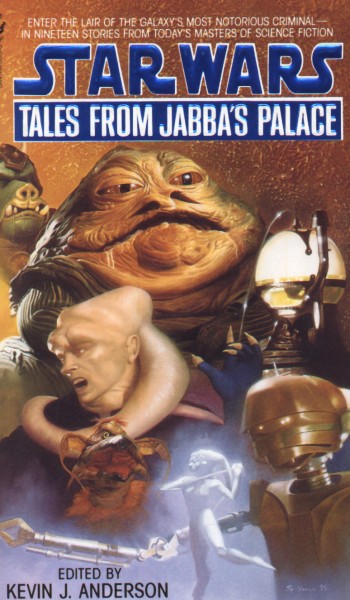
The Star Wars’ anthology novel, Tales from Jabba’s Palace (TfJP), is probably one of the most underrated stories ever to be produced in the Star Wars’ universe.  So many funny, clever, and important stories happen in this oft-forgotten book that I wonder why it’s not discussed more often.  I daresay, this is the book that help got me into Star Wars back when I was in Junior High (a time that I hardly ever read to begin with).  After reading this book, I read the other two Tales books (Tales from Mos Eisely Cantina and Tales of the Bounty Hunters) and played great Star Wars video games.  TfJP was my definitive first look behind the movie’s curtains and peer into the Star Wars Expanded Universe.

Why?  Why did this book capture me and drive me towards my eventual Star Wars obsession?

Well, remember in Return of the Jedi when Luke killed the Rancor and while he was hustled away, a chubby, shirtless guy ran forward to the now dead Rancor and begin crying?  That scene, both humorous and poignant, spoke volumes about a character, about a history, that we as an audience have not been nor will ever be exposed to.

It is this character’s history, Malakili, whose tale we read first (aptly titled “A Boy and his Rancor”) in TfJP.  A strong story to start on, we are given an in-depth look at Malakili and his developing friendship with his Rancor.  The story, one of the longer ones in the book, takes its time and shows how Malakili and the Rancor eventually trusted each other as more than just a master and his pet but as actual friends, as comrades.

As a reader, we are hooked into this story and empathize with Malakili.  He is a likable character that has goals and feelings.  All of our admiration with him, and even his Rancor, culminates in the end as the Rancor’s death leaves us even sadder than if we had only see the movie.  After reading his tale, you want to learn more about the tales that this anthology has to offer.

*sniff*

Malakili and his Rancor’s tale establishes the foundation that the rest of the anthology builds off of.  Not only do we have a good reason to hate Jabba (besides all the stuff he did in the movie) but we are exposed to the variety of characters whose journey we’ll also follow (e.g., Gartogg the Gamorrean and Porcellus the chef) later on.  Through these interactions, we realize that there is so much more going on in Jabba’s Palace than we realize and that Malakili’s tale is only a part of it.

Indeed, as you read through the anthology, a feeling of unease begins to creep into you as you read each of the characters’ tales.   The protagonists might run into a dead body with an unknown murderer or find out that their plot has gone awry by an unseen force.  Many of the questions we faced during their stories are not answered until much later in the novel though hints are certainly sprinkled here and there on who (or what) are the actual puppeteers.

Generally speaking, as you progress through the novel, the protagonists’ tales usually start or end later compared to protagonists near the beginning of the book.  Hell, many of the protagonists’ stories that make up much of the latter half of the book end with Jabba’s Barge blowing up or shortly thereafter.  Even the last two stories (Boba Fett and Yarna) take place after Jabba’s death and a majority of the time spent with these two characters does not even take place in Jabba’s Palace.  As such, the editor’s deliberate action in placing all of the tales in certain sections of the anthology give a sense of an overarching story in the novel that would seemingly be lost if the stories were randomly distributed.  The result of which is quite amusing to me.

This overarching story works really well for each of the protagonists’ tales.  The best example of this I would say is Ephant Mon’s Tale.  There seems to be a shift in our overall mood towards this novel as we read his tale.  Not only do we progress further in the timeline compared to the protagonists beforehand but we get to confront Jabba through the eyes of a friend, something that no other protagonist can claim.  It’s a different side of Jabba that we rarely see and really hones in how unique all of the characters are in this book.  More importantly, Ephant Mon’s Tale hints that the Force was acting very strong in Jabba’s Palace for the past few days.  Major events, whether seen or unseen in the movie, transpired in the awful establishment and it’s hard to believe they happened purely by chance.

Speaking of chance, I want to talk about one of my favorite protagonists, Gartogg the Gamorrean.  God, this guy is great.  He means so well but he’s just so stupid, haha!  He has this uncanny ability to stumble upon a freshly murdered body with maybe even the murderer to boot.  He’s so good at this that he found the crime scene for all four murders in Jabba’s Palace!  But everyone always tricks him for the sole reason that they don’t get into trouble with Jabba and he believes them!  And he’s just so cheery about it and wants to please his boss and oh my gosh this guy is hilarious.

One of the underlying themes in TfJP is that not everything is as it seems.  Characters that the protagonists perceive as incompetent or inconsequential are actually quite formidable or intelligent.  Ree-Yees is an interesting example of this as he disguises his competence with his alcoholic tendencies and plays the fool most of the time.  Even though he’s an idiot, his plot goes unnoticed by many people, including the conspiracy-sniffing Ephant Mon.   Bubo is probably the best example though as even the reader does not give Bubo two cents until we realize he is a sentient being!

I have to talk about the B’omarr monks as they are definitely an important part in the anthology.  Though none of the protagonists are monks, quite a few of them interact with the monks to some degree such as J’Quille, Bib Fortuna, Bubo, Tessek, and Ree-Yees.  I think because we lack a monk POV we find them unsettling as we know little about them.  Even Bib Fortuna, who arguably is the most familiar with them out of anyone in the Palace, did not foresee the Monks takeover when Jabba was killed.  When we are revealed the fate of Jabba’s Palace, there is another uneasy shift in the novel as we wonder if the next protagonist will be able to survive both Jabba’s barge blowing up and unwanted removal of their brains in jars.

At least, that’s the way I feel, especially for the last Tale involving the fat dancer, Yarna, and the hunter, Doallyn. Just as we begin TfJP with a strong story starring a likable pair of protagonists, we end it once again with two protagonists only this time, the game has changed.  We fear that Yarna and Doallyn do not have much time in the Palace as they could easily be killed by Dannik Jerriko or operated on by the creepy B’omarr Monks.  What’s more, there is an actual risk for the two that we do not experience often in the previous Tales.  The previous Tales take place (mostly) during the events of Return of the Jedi.  As such, we know who may succeed and who may fail.  Yarna and Doallyn’s Tale, however, takes place afterwards, and therefore we venture into completely unknown territory with them.  Without the movie tying them down to any plot specific requirements, the author goes all out in making their tale stand out from the rest.

And what’s more, unlike Malakili and his unfortunate pet Rancor, they succeed, ending the dour novel in a heartwarming light.

Now…

Ever since I first read this novel, I was mesmerized and impressed on how every Tale matched the other Tales almost perfectly.  The protagonists meet each other constantly and as such, the exact same interaction can be found in two different chapters.  So many of these events, which go unnoticed in the movie, are of such importance to the characters that I’m willing to bet that someone made a grand, master timeline of the events and gave it to all the authors in making sure they follow it.  The fact that these interactions happen at all always surprises me.

But as far as I know, no one has recreated this timeline.  It’s quite daunting, that’s for sure, as you would have to be a big nerd to do that.  And guess what?  I did just that!  Tomorrow, I’m going to release my interpretation of the overall timeline of Tales from Jabba’s Palace!  Check it out because I’m super proud of the end result!

If you had read the novel, I would like to hear your opinion on it as I know only a few people who have.  Who are your favorite characters and Tales?  If I were to pick my favorite Tales/Characters it would Ephant Mon, Gartogg, Malakili and his Rancor, and Yarna and Doallyn.

The Childhood Sweetheart Trope as Interpreted by 999 and Danganronpa

One of the most predictable and used tropes for anime, and in general other media, is the Childhood Sweetheart Trope (CST). A pre-ten year old boy and girl meet each other for the first time, acquire puppy love, and then are tragically separated due to extraneous circumstances before they meet up again as young adults. They fall in love again through a series of mishaps or adventures and then get married. There can be some fidgeting with this but for the most part this is basically the sub or main plot for a lot of romantic/semi-romantic anime ranging from the humorous Love Hina to the very gruesome Elfen Lied.

I am critical of this trope though for several reasons besides its foreseeable conclusions. One is that the characters, especially the female ones, are quite dull or one sided and have no overall personal goals or conflicting feelings that paint them as actual people. Two is that we as the audience already expect them to get together and thus when we see the boy or the girl dating someone else we know it will end badly. Three is that the trope has a very predestined feel behind it, especially if the boy and girl make a marriage promise, as the girl and boy are fated towards this end result no matter what they do. Finally, the girl characters are treated like rewards or trophies for the boy, especially if we primarily follow the boy’s POV, and not as actual humans.

Now I know this is not always the case (e.g., Elfen Lied) but CST is certainly prevalent in the story telling community. As such, I want to discuss two stories, the DS game 999 and the visual novel game/anime Danganronpa, and their unique interpretation of this dry trope. These two stories have an interesting approach to this tired theme and I wanted to gush why I think these two nailed it (and of course, spoilers).

Lower row, directly in the middle is Makoto and to his right is the blue-haired Sayaka. Image from http://www.egmnow.com/articles/reviews/egm-review-danganronpa-trigger-happy-havoc/#

Let’s start with Danganronpa, our main character, Makoto Naegi, likes Sayaka Maizono, a pop idol girl, whom he became acquainted with in middle school. The two hadn’t seen each other until the events depicted in Danganronpa and they hit it off well as they’re the only people they’re familiar with in the whole cast of characters. There is an implied mutual attraction and support between the pair.

Though they didn’t know each other before middle school, this is still the CST at heart as they were separated at a young age before being reacquainted several years later. When the terrible events of Danganronpa unfold, the story seems to set up the notion that their relationship will only get stronger before they become an actual couple.

However, this does not happen as a fellow student murders Sayaka and as such, we see the first twist Danganronpa offers for the CST. Makoto and Sayaka’s relationship will not blossom but Sayaka now becomes a martyr for Makoto, a beacon to for Makoto to triumph in the end.

Although Sayaka’s death may be inspirational, she is still a rather flat character. That was the case until an episode after her death revealed her hidden intentions. Sayaka, in all her innocent goodiness, was planning on murdering a fellow student and then frame Makoto for it. Of course, the murder doesn’t go as plan and she got murdered instead. This shocks both Makoto and us the viewer. We are set up at the beginning that Sayaka would be an innocent, loving girl and yet her actions had proved otherwise. Why did she do it? Well, we’re shown in the previous episode that her band members were severely hurt/already dead and probably would not be saved unless she murdered someone and successfully got away with it.

This…is awesome.

Her reasons for murdering actually seem sensible (besides, you know, the whole murder thing). Her band members are in grave danger and she has known them for years, they’re probably like family to her! Seeing them in peril prompted her to act the way she did so she could try and save them. She tricked Makoto into switching rooms with her, lured a student to the said room for the promise of teaching him music, and then attempted to murder that student and blame it on Makoto. Since she barely knows Makoto, she didn’t have any strong emotional attachment to him and thus didn’t have a problem in framing him for murder. I actually want to see an alternate universe where she did murder the student and and how Makoto would react to that.

Though I kind of thought she would be the first one to get murdered, I definitely did not see her ulterior motives coming and was nicely surprised by it. These first few episodes definitely set the tone for the rest of the series. Well played, Danganronpa.

Guy in the middle frame with the blue vest is Junpei and to his right is Akane.  Image from http://zeroescape.wikia.com/

Nine Hours, Nine Persons, Nine Doors just takes this trope though and blows it out of the water. Now, this game has so many ideas, themes, and morals behind it that I try to find any excuse to talk even just one of them. In this case, I want to talk 999’s interpretation of the CST as it’s just amazing.

Our main character is Junpei, a 21-year-old college student who is found on a rigged-to-blow cruise liner and must play the “Nonary Game” in order to escape from it. He meets eight other characters after escaping from his cabin room, one of which is Akane Kurashiki (alias “June”), whom he knew when they were kids. IMMEDIATELY, when Junpei explained who she was I was like “Ah, crap, here we go, another Childhood Sweetheart story.” I was not looking forward to Akane and I actively avoided her early on in the game. She seemed like such a flat character, another one of those innocent, sweethearts or whatever.

Well, as you may know, there are multiple endings to the game. After the first time through (I died of course), I went a different route but this time I actively engaged with Akane more often.

Holy crap, she’s funny, and a bit crazy too. Her sexually suggestive quips embarrassed Junpei (lol) and her crazy metaphysical concepts made him question her sanity. I was happily surprised how untypical she was while I was playing the game.

In fact, the more I played the game the more I realized that there was something really special about Akane but I couldn’t figure out why.

And then, wham, I came across the true ending to the game and my mind was blown. It was revealed that all along she was the one behind the “Nonary Game” and it was all an elaborate setup to not only get back at the people who hurt her ten years ago but also to save her from her own death.

Okay, where to begin.

When Akane was a kid, she was trapped in a room that was going to burn her alive. Her only way out was to solve a puzzle that she didn’t know how to answer. Her only way out was to telepathically communicate Junpei and have him solve the puzzle instead. How? Well, this is the part where things get crazy. One of the themes of the game is that the past is set but the future has multiple paths laid out. Akane tapped into that idea by communicating to Junpei ten years in the future and have him solve the puzzle instead. Her future self created an environment that was exactly similar to her past’s environment. This allowed Past Akane to look into the different future paths and try to steer Junpei to the puzzle that she could not solve. This is why the game has multiple endings (which blew my mind, this game did that a lot for me), Akane is trying to find that perfect ending. Once Junpei figured out the puzzle in the exact same environment, he telepathically communicated the answer back to past Akane and then she was able to figure it out.

This is actually why present Akane would inexplicably collapse when she and Junpei were exploring their environments. If the player chooses a wrong path (i.e., the path that takes them to the life-or-death puzzle) then present Akane would become sick because Junpei is not exposed to the puzzle, which means he can’t solve it, which means he can’t communicate the answer back to past Akane, which means she will die in the burning room, which means present Akane will die as well. Wrap your head around that one.

There are internet articles out there that like to deconstruct this concept into pieces and explain why this is so amazing so I won’t go into that. But what I do want to say is that all of this…the telepathy, the puzzles, the multiple endings, and the character herself just utterly destroy the CST. Whether done intentionally or not, 999 builds up CST and then just tears it down piece by piece and I really liked that. It’s not often that a storyteller has effortlessly guided my initial opinion of a character into making me think one way of them and then pull the rug from me and reveal what truly lies there. So good.

Image from Amazon.com

Okay, so what do these two stories have in common?  Why do I like them both?

Both of them set up the boy and girl’s relationship very casually, almost as if they were simply cookie-cutting the trope into their twisted plots but still keeping true to CST.  In Danganronpa, Makoto and Sayaka would get out of the murder game alive and become a couple; in 999, Junpei and Akane defeat Zero through the power of a emerging love.  However, this does not happen.  We are given a scenario where both Sayaka and Akane have ulterior motives and are trying desperately to win no matter what the costs.  We see what makes them tick and why they acted the way they did.

I guess what I’m trying to say is that these two females felt like actual people to me.  They feared, they planned, they made hard decisions, and they are not defined by simply trying to find that special someone or being in love.  That may be a part of them yes but it’s not the full picture.  I really liked that but it’s unfortunate that these characters stood out to me because they directly oppose a rather flat trope.  Regardless, because of their actions, they are what help make 999 and Danganronpa great as they took this trope and punched it right in the face.  Now that is awesome.

Unapologetic Nerd will be on hiatus next week in preparation for an extensive Star Wars article for Star Wars Day.  It will focus on one of my favorite novels in the series.  Don’t forget to check it out!

Pokemon in the Biology Lab

I’ve been teaching introductory biology labs for several semesters now and if there’s one thing that I learned it’s that you have a limited time to teach your students the current week’s material before they get bored. Most of the time, this is not an issue as students have already become familiar with the topic thanks to the lecture. As such, lab lecture is more or less reminding students of the material and less of teaching them something new. After a short introduction we get right into the lab and have some fun.

But for the times when the lab is covering something new, things can get a little tricky. I heard somewhere before that you have five minutes to teach your students the pre-lab material before they begin to zone out. Five minutes, unfortunately, is painfully short and as such, I try to mix things up as best as I can so my pupils can continue to remain engaged (one time I even dressed up as a Eukaryotic cell and asked my students what each of my organelles do to keep me alive).

Such as the case two weeks ago when we tackled the vertebrate diversity lab. One of my favorite labs ever, the students were divided into three groups and each group dissected three different vertebrates; a lamprey, a dogfish, a perch, a mudpuppy, a frog, an anoles lizard, a turtle, a pigeon, and a rat. These animals represented the numerous broad groups of vertebrates; agnathans, chondrichthyes, osteichthyes, amphibians, squamates, turtles, archosaurs, and mammals. The overall message for that week’s lab, through the dissection of the nine animals, was that vertebrates have all evolved from a simple body plan to accommodate their environment and lifestyles.

Now, on the whiteboard, I had drawn a simplified version of a vertebrate phylogenetic tree as provided to the students by their lab book. However, as I was talking about each group of animals, I would slap on a printed-out picture of a Pokémon as an example of that animal such as Eelektross for agnathans.

pokemon phylogenetics, vertebrates, pokemon

Yes, I know this vertebrate tree is highly simplified but this was the level of education the lab was focusing on for the students. The class textbook goes into greater detail about the intricate relationships. All images are from bulbapedia.

Eelektross is always the first animal/Pokémon I would use as it represents the first branch off of the tree. Immediately, once I place this Electric-type Pokémon on the tree, everyone sits up and takes notice. I like to think that I have jarred them out of their sleepy, spaced-out zone and thrust them into something that they don’t know about (if they’re not Pokémon fans) or have much interest in (if they are Pokémon fans). Even if they’re not familiar with Pokémon, I would give my students a real life example of that animal it represents (lampreys) and then explain what sets this animal apart from all the other animals in the small phylum. After doing so, I would continue to the other animal branches and elaborate what makes them so special all the while continuing to slap on example Pokémon on the whiteboard.

Besides doing this for comedic sake, I like to use Pokémon for two reasons. One, using Pokémon is a way to get students interested in the subject manner at hand. Many of my students are pre-Med or pharmaceutical majors and that’s totally fine. But here, at the doorstep of all that is biology, where students are exposed to so many different topics that they will never tackle again in their future, I try my damnedest to show them how awesome those weird and unique topics are even if they may be as seemingly uninteresting as plants or population genetics. I know I will not convince many of my students to change their chosen path in life but if I have just one student that just stopped and ponder briefly whether they should pursue another topic in biology because of my lab, then I have succeeded. Using Pokémon is just one of many ways I try to generate excitement of all that is biology (paleontology is another one as well, of course).

The second reason why I like to use Pokémon is that I try to encourage a friendly, welcoming environment in my lab. I like to have a lab where people can be themselves. My icebreaker question even sets the tone for my labs as I ask each of my students what they’re nerdy about. Let me tell you, this question is great as I get to learn so much from my students and I get to relate to them for that particular hobby at hand or a hobby that’s close to it. I even like to chat to them as the semester progresses about certain news that may pertain to their nerdy hobby such as a recent episode in Game of Thrones or a movie update for the Marvel Cinematic Universe.

Be yourself and be open to new ideas. As gimmicky as these may sound, I adhere to them like a barnacle on a hard substrate. I don’t know how well these two ideas have been picked up by my students, but I will say that they…I don’t want to necessary say “enjoy”…but certainly like my labs judging by my evaluations. I hope though in the long run, maybe 10 or even 20 years from now, they’ll remember my lab lectures and one day recall, while playing Trivia Pursuit, that Mantine is a manta ray and all manta rays are chondrichthyes and then they’ll win the game! But I’m just fantasizing at this point.

One Year Anniversary for Unapologetic Nerd (with my favorite articles)

One year ago to this day I published my first article for Unapologetic Nerd. This blog was a test. A test to see if I could publish an article every week for one year. So many blogs on the internet become inactive after only a few months of use. I resolved not to let that happen. And I’m happy to say that, beside a few minor exceptions, I was able to keep that promise! Today marks the 70th article of my year long blog.

The best part is how much this blog has grown since I first began. From April 7th to the 30th, 2014, I had less than a hundred views total. However, just last week on the 1st, I well exceeded that mark. I sympathize with a lot of bloggers out there who may get discouraged easily. Blogging is no easy task. Don’t expect instant and huge feedback. Even now, I’m still on the low end compared to a whole bunch of other blogs.

But I like to think it’s not about view count. I like to think that this blog has been an accumulation of me as a person, who I am and what I love and what I like to think about. I may write about what’s popular every now and then but I also like to write about obscure things that I’m a nerd about such as Columbo, Chrononauts, and Harry Turtledove even if they are my lowest viewed articles.

Honestly, the biggest reason why I started blogging was so I could become an intern at the national parks. The applications for them always have a section for electronic media experience, something that I’m woefully unacquainted with. But this past year, I became familiar with both blogging and podcasting. The results? It was a success! This blog, the podcast, my teaching, and much more have helped me become an intern at Fossil Butte National Monument this summer! Needless to say, I’m looking forward to it.

Now, will I continue writing? I like to think so. This website has slowly become less of a chore and more of who I am and what I do. I might take a break now and then to recharge or to make higher quality articles but I still have ideas and articles that I can still write. Even now, I have been forcing myself to write more thoughtful and thesis-like articles and less on reviews for video games or board games (even though they’re still fun to write).

However, my current thesis work has been challenging and time engaging and has forced me to move away from my blog. Again, I’m glad this anniversary has come up as I’m worried the quality of my articles has been lacking as of late. I want to make sure my thesis is of high quality even if it’s at the cost of my blog. Regardless, I will continue writing on here cause I love doing it and I love seeing other people read it even if I still get less than a hundred views a day, haha.

Without further ado, I want to list my favorite articles from the past year. These are articles that I think were written well, or a lot of people seemed to like or comment on, or even ones that seem to garner consistent readers. I aspire to continue to make quality articles like these and maybe even surpass them one day. Link’s in the description!

02_Our_War_Game

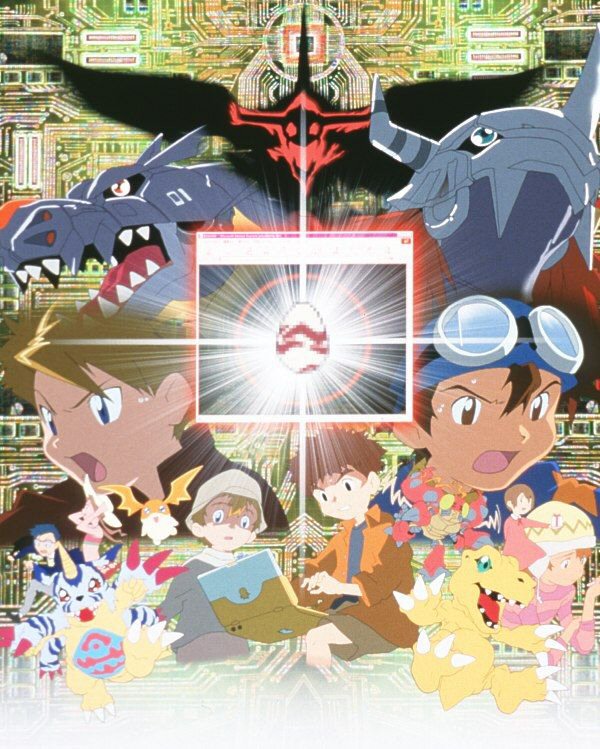
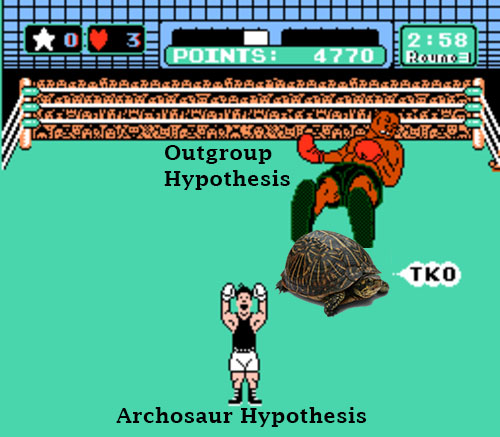
Digimon Our War Game: Dub vs. Sub and Summer Wars and Digimon: Our War Game are Both Great Films: Both of these articles were popular on the digimon subreddit and even one of my favorite podcasts ever, Podigious, commented how they liked my Sub vs. Dub article! That was definitely a highlight for my blog. They rank high on the viewership, got some great replies, and I honestly feel like I have given both articles some fair and comparative analysis. These articles are probably my favorite on my blog. Plus, it didn’t hurt that the source material these articles came from was great quality!

The Cartoon Network Renaissance: This is my highest viewed article without any subreddit influence. I really appreciate the layout of this article as it doesn’t start off with some exposition. That’s one problem I’ve been facing while writing articles, a boring introduction caked with exposition. But the exposition that is in there is well placed and continues smoothly. And I just like this article in general.

My Feelings on Over the Garden Wall (Spoilers): Another good article that has a great opening. I really poured my heart into this one. Also, a lot of my articles, admittedly, were written the night before and it certainly shows. Even though this article was also written the night before, it’s still pretty good! I like this one.

Nostalgia Filter Test: Jackie Chan Adventures: My first Nostalgia Filter Test article. It was fun rewatching Jackie Chan Adventures (except season 5…) and the show held up better than I expected it to. I also just like talking about Jackie Chan Adventures so any excuse to do so is a good excuse. I need to do another NFT in the future…I got one in mind but I’ll cross that bridge when I have the time to do so.

If the actual ref was here, the turtle ref would have been used in kart racing.

Why Turtle Science is Good Science: I mentioned before how science articles take a long time to write so I haven’t written that many of them unfortunately. They can also be convoluted or heavy if not written well. This one though, my first science article, is really slick and I got a lot of nice feedback on it. It’s really a great article I think.

He Died as He Lived: Karl Patterson Schmidt: The turtle article may be my favorite science article but this one still ranks up there. This article especially needed to be handled carefully since it does involve a death after all.  I like to think I handled the circumstances surrounding Dr. Schmidt’s death well while still pointing out the irony of the situation.  I also like how short and to the point it is. I also like how its featured on the first page of Google which is a nice bonus.  I have another HDaHL article in mind but I won’t publish it until I know it’s ready.

steghost

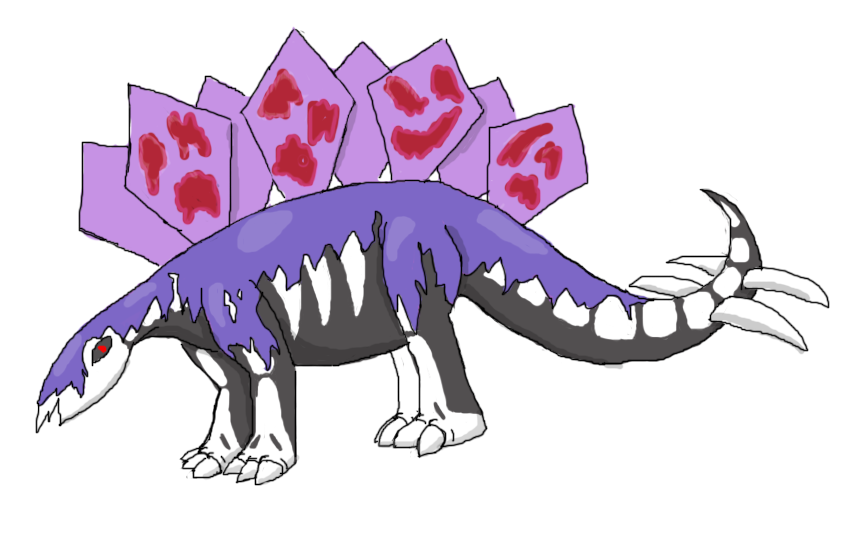
Ancient Animals and their Fakemon: Stegosaurus: And finally, save one of the best for last. There have only been three AAatF on this blog. I wish there were more but these articles definitely take the longest to make. Mary has to draw the fakemon while I have to write an accurate, up-to-date article about the animal at hand. We’ve been kicking around with a few fakemon but they haven’t gotten off the ground yet.

Stegosaurus (and Steghost) is the best among the three as it’s nicely polished, well fleshed out, and the fakemon was nicely crafted. Everything about Stegosaurus I talked about affected Steghost in one form or another. I like how Mary interpreted Steghost and gave it a nice spooky vibe. Thagomize also remains one of my favorite fake-attacks ever, it’s so awesome and I wish it actually existed. Hell, Steghost is just so cool that I would train the hell out of it, haha. This article is definitely one of my favorites and I always like it when an article comes out so perfect (and if there’s an ancient animal you would like us to do then give a shout!).


Well, that’s it for my list. As for the future, well that’s still up in the air. I know I’ll be writing for a long time as I still have article ideas but when the internship happens, I might place the blog on hold or I might not. Really, I’m playing it by ear at this point. But for you, dear reader, I thank you for reading this and I hope you have a wonderful day!

One Year Later: Evaluating my Super Smash Bros Predictions

One year ago, I was preparing to start my own weekly blog by prewriting several articles to ensure I would meet my self-imposed deadline. Unfortunately, my blog started much earlier than expected thanks to an ill-timed Nintendo Direct video. The unlikely article that was now forced to become my first article for Unapologetic Nerd was “Possible New Smash Bros Characters.” I want to look back now and evaluate how good were my guesses. Some of them I got right, others I got close to, while the rest I was completely wrong about.

The Ones I got Right

Only two characters from my list were correct and granted, this is pretty good all things considering! The Mii Character was the first one and although I envisioned Mii using a variety of everyday objects such as a tennis racket or a golf club as weapons, Nintendo surprised us with a diverse character that could be a brawler, a shooter, or a swordsman. Still though, the inclusion of Mii into Super Smash Brothers was still an obvious choice thanks to their ubiquitous presence from the past seven years or so.

Less of an obvious choice was Mewtwo. Like so many other fans, I hoped dearly that Mewtwo would make a return even though it seemed unlikely thanks to the large amount of Pokémon fighters. Initially it seemed like he wouldn’t but that changed thanks to the Super Smash Brothers-only Nintendo Direct and its great reveal of Mewtwo. And let me tell you, I’m super looking forward to playing him again!

Characters I almost got Correct

Last year, I strongly predicted that Chrom from Fire Emblem: Awakening would be a new fighter. I was…not quite correct…Lucina was the first new character but the more new interesting character was Robin. Robin answered my problem with Chrom as I thought of him as too similar to the other swordfighters. Robin, however, was more diverse using both magic and swords to fight his opponents. And hey! Chrom makes an appearance anyway in the final smash for Robin!

Completely Wrong

Last year, I was predicting many favorite Third Party characters that starred in Nintendo consoles such as Simon Belmont, Bomberman, Professor Layton, and Banjo-Kazooie. I also guessed characters from already-represented franchises like Ryu and Phoenix Wright (CAPCOM) and Tails (SEGA). Third Party Characters were unfortunately low this time but I still can’t believe I missed one of the most famous video game characters of all time, Pac-Man (who is super fun to play btw!).

King K. Rool and Paper Mario also unfortunately didn’t make the cut despite how amazing both of them would be. I’m especially sad about the King K. Rool as we definitely need more bad guy as well as Donkey Kong representatives.

But…

The best part about all of this though is that there is still a chance that these characters can be in the game! Ever since Nintendo revealed in their latest Nintendo Direct that you can vote for a new Super Smash Brother character, I have seen a wide variety of requests from various screenshots promoting many of the characters I have talked about here. What’s more, Nintendo allowing third party characters to be included has open the door for a diverse set of possibilities. Many of the developers and owners of these characters have already expressed interest for their character to be featured in the game including WayForward’s Shantae, TeamMeat’s Meatboy, and perhaps most exciting of all, Xbox’s Banjo-Kazooie.

If I were to guess, we probably won’t be hearing about character selection anytime soon. Maybe at the earliest they’ll be announced in Autumn but more realistically speaking I’m thinking we’ll know by early next year. Still though, if my blog were to continue on for another year, I’m pretty sure I’ll be writing another article evaluating my predictions from the new DLC characters and I hope this time, Bomberman will finally be chosen.

Tomorrow, I’ll post my one year anniversary article where I pick my favorite articles I have written and a little about my experience on the website. Thanks for reading!